‘Universities are ideal centres to connect people with right ideas’
Date :26-Nov-2026
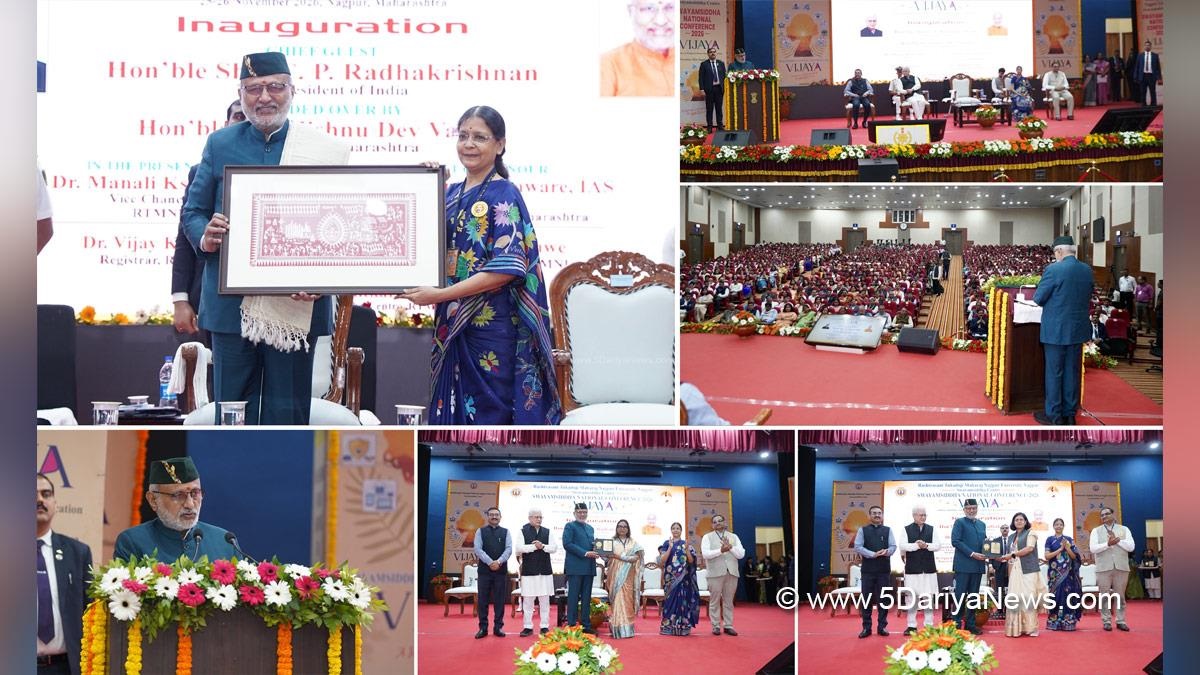
C P Radhakrishnan, Vice-President of India, inaugurating the logo of ‘Swayamsiddha’ in presence of (from left) Dr Prashant Narnaware, Secretary to the Governor of Maharashtra;
Jishnu Dev Varma, Governor of Maharashtra, Dr Manali Kshirsagar, Vice-Chancellor, RTMNU and Dr Akhilesh Peshwe, Pro-Vice-Chancellor, RTMNU.
Staff Reporter :
C P Radhakrishnan inaugurates Swayamsiddha-VIJAYA national conference in city; Governor Jishnu Dev Varma stresses on skills and economic independence
“Universities are ideal centres to connect people with the right ideas and purpose,” said C P Radhakrishnan, Vice-President of India, while inaugurating the two-day Swayamsiddha National Conference-2026, titled ‘VIJAYA’, at the National Fire Service College, Police Line Takli, on Wednesday.
Organised by Rashtrasant Tukadoji Maharaj Nagpur University (RTMNU) through its Swayamsiddha Centre, the VIJAYA (acronym for Vision-Inclusion-Justice-Agency-Young Women as leaders-Achievement) conference focused on women’s empowerment and leadership.
Jishnu Dev Varma, Governor of Maharashtra, presided over the inaugural programme, while Dr Prashant Narnaware, Secretary to the Governor of Maharashtra, was the guest of honour.
Also present on the dais were Dr Manali Kshirsagar, Vice-Chancellor, RTMNU and Dr Akhilesh Peshwe, Pro-Vice-Chancellor, RTMNU.
In his address, Radhakrishnan said he had a special attachment to Swayamsiddha, an initiative he had started during his tenure as Governor of Maharashtra. He appreciated RTMNU for expanding the initiative and said higher education institutions must go beyond imparting education and create opportunities for women to enter leadership roles.
Recalling women’s contribution to India’s constitutional history, Radhakrishnan pointed out that 15 women were members of the Constituent Assembly that framed the Constitution. The observation assumes particular significance as India celebrates Constitution Day on November 26, commemorating the adoption of the Constitution. He also observed that women often outnumber men among university
gold medallists.
Referring to the place accorded to mothers in Indian culture, the Vice-President said they were regarded with divine respect and often played a decisive role in family matters. He stressed the need to ensure that no child was left out of education and called for efforts to bring school dropouts down to zero.
Opportunities, he said, must extend from classrooms to research laboratories and leadership positions. Students’ interests and talents should be identified and nurtured early, with motivation provided to all. He said the broader objective should be to move from women’s empowerment towards women-led empowerment and development. Radhakrishnan also emphasised that women’s empowerment was not the responsibility of universities and colleges alone. Families and all sections of society must participate in the process. Varma underlined the importance of skill development, vocational training, access to resources and economic independence in empowering women. He called upon universities to actively support Swayamsiddha and equip students with skills, leadership abilities and vocational training. He expressed hope that Maharashtra would emerge as the country’s leading State in women’s empowerment. Dr Manali Kshirsagar said education was the strongest catalyst for realising women’s development. She also delivered the Anti-Drug Pledge during the programme.
The university’s Swayamsiddha logo was inaugurated by the Vice-President, who also released the compendium ‘Hundred Voices’. Five women achievers were felicitated by Radhakrishnan: Dr Ujjwala Chakradeo, former Vice-Chancellor, SNDT Women’s University, Mumbai; Padma Shri Dr Kalpana Saroj, head of the Institute of Women Empowerment, Mumbai; Dr Neena Gogate of Swami Ramanand Teerth Marathwada University, Nanded; Dr Pratibha Desai of Shivaji University, Kolhapur; and Dr Shalini Lihitkar of RTMNU. Dr Vijay Khandal, Registrar, RTMNU, was also present. Dr Shalini Lihitkar was the
organising secretary of the conference.