Constitution Gallery in Legislative Assembly
| Date :27-Nov-2026 |
Staff Reporter :
ON THE occasion of the 77th
‘Constitution Day’, the Madhya
Pradesh Legislative Assembly has
distinguished itself by establishing a ‘Constitution Gallery’ to
honour the visionaries who represented the State in the
Constituent Assembly.
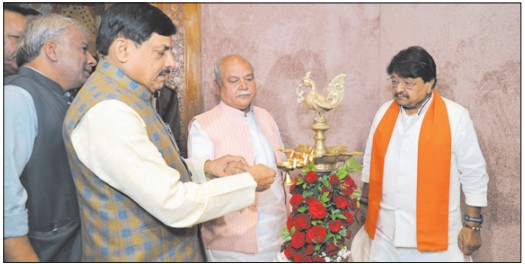
The gallery was inaugurated by
the Chief Minister, Dr Mohan
Yadav, alongside the Speaker of
the Legislative Assembly,
Narendra Singh Tomar (who
presided over the event),
Parliamentary Affairs Minister
Kailash Vijayvargiya, and
Lokayukta Justice Satyendra
Kumar Singh. During the event,
the guests joined by chairpersons and members of various
commissions, as well as ViceChancellors of universities,
unveiled a special edition of the
Legislative Assembly’s journal,
‘Vidhayini’. This issue contains
a collection of diverse articles on
the Constitution and material
detailing Madhya Pradesh’s contribution to its drafting.
The ‘Constitution Day
Celebration 2026’ commenced
with the guests offering floral
tributes at the statue of Dr
Bhimrao Ambedkar, located
within the Legislative Assembly
premises. The launch of the journal ‘Vidhayini’ began with a collective recitation of the Preamble
to the Constitution, led by
Assembly Speaker Narendra
Singh Tomar. Following the
unveiling, Chief Minister Dr
Mohan Yadav remarked in his
address that the Preamble to the
Constitution, as recited today,
includes a reference to the
‘Vikrami’ (Vikram Samvat) calendar alongside the Gregorian
date. He noted that while the
Constituent Assembly had originally accepted the Vikram
Samvat, a committee formed later, in 1955, decided to replace it
with the Saka Samvat. He urged
reflection on why the Vikram
Samvat was omitted from the
Constitution that had been
adopted on November 26.
Further more, he pointed out that
Article 35A was introduced in
1954 without following the established constitutional amendment process. He suggested that
this reflects the attitude of the
individuals of that era toward the
Constitution. Similarly, during
the Emergency, the constitutional framework was dismantled. Through constitutional
amendments, the powers of the
judiciary were curtailed.
Highlighting the role of
Madhya Pradesh in the
Constituent Assembly, Chief
Minister Dr Yadav noted that
members from the State, including Seth Govind Das and Hari
Vishnu Kamath, advocated for
adopting the name ‘Bharat’
instead of ‘India’. Kamath fought
against the suspension of
fundamental rights. The
Supreme Court of India was
established following an initiative by Dr Hari Singh Gour.
Pandit Ravishankar Shukla
proposed a framework for the
distribution of revenue
between the State and the
Centre, a concept that laid the
groundwork for the current
GST system. Our State has
implemented a Uniform Civil
Code; this issue was raised in
the Constituent Assembly by
Rajkumari Amrit Kaur, who
represented Madhya Pradesh.
Furthermore, the late
Dinanath Bhargava from
Indore designed the Ashoka
Emblem featuring the four
lions. Presiding over the event,
the Speaker of the Madhya
Pradesh Legislative Assembly,
Narendra Singh Tomar, stated
that our ancestors waged an
untiring struggle and
embraced the gallows with a
smile. It is as a result of this
sacrifice, this freedom, soaked
in the blood of martyrs, that
we have attained our independence. It is through this
that we have been gifted our
Constitution, which is dearer
to us than life itself. We are fortunate that, through this foundation document, we are able
to serve and contribute to the
lives of millions of our countrymen. We take pride in the
fact that our Constitution is allencompassing and inclusive.
Tomar added that, while drafting the Constitution, our
ancestors envisioned a nation
where every individual is
bound by equality, equity, and
compassion, a nation where
everyone enjoys equal rights,
and where every person
receives what is rightfully
theirs. The Constitution also
serves as an inspiration for us
to fulfill our duties. Today, we
can say with pride that India’s
75-year journey since independence has been completed. In this ‘Amrit Kaal’ (an era
of nectar/opportunity), Prime
Minister Modi has called for
India to become a ‘Viksit
Bharat’ (Developed India) by
2047. Working towards this
goal, the state government,
under the leadership of Dr
Mohan Yadav, is making dedicated efforts, in co-ordination with the Central
Government and various institutions. These endeavours will
succeed, and the dreams envisioned today will be realised
by 2047.
Minister of Parliamentary
Affairs Kailash Vijayvargiya,
noted that in his first address
as Prime Minister in the
Central Hall of the Lok Sabha
in 2014, Modi stated that to
make the nation strong, the
impoverished sections of society must be empowered, a
vision that aligns with the spirit of the Constitution. For the
first time since independence,
a concerted effort was made
to ensure that every citizen
could live a better life.