Constitution Gallery in Legislative Assembly
| Date :27-Nov-2026 |
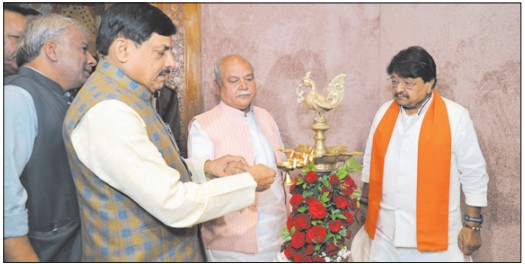
Staff Reporter :
ON THE occasion of the 77th
‘Constitution Day’, the Madhya
Pradesh Legislative Assembly has
distinguished itself by establishing a ‘Constitution Gallery’ to
honour the visionaries who represented the State in the
Constituent Assembly.
The gallery was inaugurated by
the Chief Minister, Dr Mohan
Yadav, alongside the Speaker of
the Legislative Assembly,
Narendra Singh Tomar (who
presided over the event),
Parliamentary Affairs Minister
Kailash Vijayvargiya, and
Lokayukta Justice Satyendra
Kumar Singh. During the event,
the guests joined by chairpersons and members of various
commissions, as well as ViceChancellors of universities,
unveiled a special edition of the
Legislative Assembly’s journal,
‘Vidhayini’. This issue contains
a collection of diverse articles on
the Constitution and material
detailing Madhya Pradesh’s contribution to its drafting.
The ‘Constitution Day
Celebration 2026’ commenced
with the guests offering floral tributes at the statue of Dr Bhimrao
Ambedkar, located within the
Legislative Assembly premises. The launch of the journal
‘Vidhayini’ began with a collective recitation of the Preamble to
the Constitution, led by Assembly
Speaker Narendra Singh Tomar.
Following the unveiling, Chief
Minister Dr Mohan Yadav
remarked in his address that the
Preamble to the Constitution, as
recited today, includes a reference
to the ‘Vikrami’ (Vikram Samvat)
calendar alongside the Gregorian
date. He noted that while the
Constituent Assembly had originally accepted the Vikram Samvat,
a committee formed later, in 1955,
decided to replace it with the Saka
Samvat. He urged reflection on
why the Vikram Samvat was omitted from the Constitution that had
been adopted on November 26.
Furthermore, he pointed out
that Article 35A was introduced
in 1954 without following the
established constitutional
amendment process. He suggested that this reflects the attitude of the individuals of that era
toward the Constitution.
Similarly, during the
Emergency, the constitutional
framework was dismantled.
Through constitutional amendments, the powers of the judiciary were curtailed.
Highlighting the role of Madhya
Pradesh in the Constituent
Assembly, Chief Minister Dr Yadav
noted that members from the
State, including Seth Govind Das
and Hari Vishnu Kamath, advocated for adopting the name ‘Bharat’ instead of ‘India’. Kamath fought against the suspension of fundamental rights. The Supreme Court of India was established following an initiative by Dr Hari Singh Gour. Pandit Ravishankar Shukla proposed a framework for the distribution of revenue between the State and the Centre, a concept that laid the groundwork for the current GST system. Our State has implemented a Uniform Civil Code; this issue was raised in the Constituent Assembly by Rajkumari Amrit Kaur, who represented Madhya Pradesh. Furthermore, the late Dinanath Bhargava from Indore designed the Ashoka Emblem featuring the four lions. Presiding over the event, the Speaker of the Madhya Pradesh Legislative Assembly, Narendra Singh Tomar, stated that our ancestors waged an untiring struggle and embraced the gallows with a smile. It is as a result of this sacrifice, this freedom, soaked in the blood of martyrs, that we have attained our independence. It is through this that we have been gifted our Constitution, which is dearer to us than life itself. We are fortunate that, through this foundation document, we are able to serve and contribute to the lives of millions of our countrymen. We take pride in the fact that our Constitution is allencompassing and inclusive. Tomar added that, while drafting the Constitution, our ancestors envisioned a nation where every individual is bound by equality, equity, and compassion, a nation where everyone enjoys equal rights, and where every person receives what is rightfully theirs. The Constitution also serves as an inspiration for us to fulfill our duties.
Today, we can say with pride that India’s 75-year journey since independence has been completed. In this ‘Amrit Kaal’ (an era of nectar/opportunity), Prime Minister Modi has called for India to become a ‘Viksit Bharat’ (Developed India) by 2047. Working towards this goal, the state government, under the leadership of Dr Mohan Yadav, is making dedicated efforts, in co-ordination with the Central Government and various institutions. These endeavours will succeed, and the dreams envisioned today will be realised by 2047. Minister of Parliamentary Affairs Kailash Vijayvargiya, noted that in his first address as Prime Minister in the Central Hall of the Lok Sabha in 2014, Modi stated that to make the nation strong, the impoverished sections of society must be empowered, a vision that aligns with the spirit of Constitution. For the first time since independence, a concerted effort was made to ensure that every citizen could live a better life.