‘Crop, water planning crucial to tackle drought’
| Date :28-Nov-2026 |
Staff Reporter :
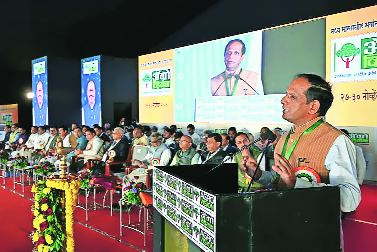
“Maharashtra has received around 20 per cent less rainfall than the average this year, making judicious use of available water essential,” said Dr Himanshu Pathak, Director General, International Crops Research Institute for the Semi-Arid Tropics, Hyderabad, (ICRISAT), at the Pani Parishad organised as part of Agrovision 2026 on Friday. The Pani Parishad was held on the theme of ‘Combating Drought: Water Management and Crop Planning’. Dr Sharad Gadakh, Vice-Chancellor, Dr Panjabrao Deshmukh Krishi Vidyapeeth, Akola (PDKV); Ad Nilesh Helonde Patil, President, Late Vasantrao Naik Shetkari Swawalambi Mission; and Vidarbha Bhushan awardee Sandeep Shirkhedkar also participated in the workshop.
Dr Pathak highlighted the need of crop and water planning in current changing climatic conditions. “Drinking water must be given priority, along with water and fodder for livestock. Agriculture should receive water only after these essential requirements are met,” said Dr Pathak.
Dr Pathak also stated that farmers should be encouraged to cultivate crops that require less water. “Crop planning at the block level and timely availability of quality seeds are equally important,” he stated.
He stressed the need to use technology to provide farmers with real-time information suited to local conditions. Government schemes at both the Central and State levels, he said, should adopt a water-centric approach.
He expressed confidence that coordinated efforts by the government, agricultural universities and research institutions could help address drought-related challenges.
Shirkhedkar presented details of water conservation initiatives undertaken under the Tamaswada and Ramtek models. He said tarpaulin-based check dams were being constructed under the Ramtek Model through the initiatives of Adv Ashish Jaiswal and Chandrashekhar Bawankule, State Revenue Minister and Guardian Minister of the district. “Public participation has been central to the success of this initiative,” said Shirkhedkar, noting that political leadership, farmers, voluntary organisations, corporate social responsibility initiatives and the government had worked together. Dr Gadakh, in his address, outlined initiatives being implemented by PDKV for conservation of water, saying their efforts have benefited both farmers and the institution.
Helonde Patil spoke about fodder management and described fodder cultivation initiatives undertaken at various
locations, which, he said, had benefited farmers.