Bhalukona mineralisation potential crosses 4 million tonne mark
| Date :03-Nov-2026 |
Staff Reporter
RAIPUR,
FRESH geological modelling
at the Bhalukona nickel-copper-platinum group elements
(PGE) prospect in Mahasamund
district has indicated mineralisation exceeding four million
tonnes, marking a significant
advance in Chhattisgarh’s
exploration of strategically
important minerals.
Deccan Gold Mines Limited
(DGML), which availed geological documentation and drillcore imagery to The Hitavada,
has estimated an average grade
of approximately 0.24 per cent
nickel equivalent, incorporating weighted contributions from
nickel, copper, platinum and
palladium. The preliminary
model covers only 300 to 350
metres of an identified 1.3-kilometre mineralised corridor.
The assessment follows
DGML’s announcement of nick- el-copper-PGE sulphide min- eralisation in May. By early June,
nine boreholes totalling
approximately 1,200 metres
had established mineralisation
along a 430-metre strike length
and beyond 200 metres in
depth. The expanded programme comprises 15 diamond-core boreholes spanning
2,773 metres.
According to the company’s
geological interpretation, a
layered mafic-ultramafic formation hosts a mineralised
corridor exceeding 100 metres
in width, extending approximately 1.3 kilometres and
reaching depths beyond 200
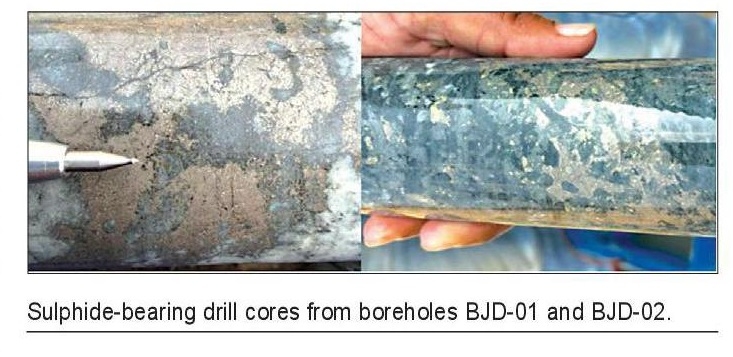
metres. Drill cores show disseminated and locally heavyto-massive sulphides, principally pyrrhotite, pentlandite and
chalcopyrite, associated with
nickel, copper, palladium and
localised platinum.
Borehole labels such as BJD01 and BJD-02 identify individual drilling locations and their recovered cores, which is notably, the prefix BJD appears
to refer to Bhalukona-Jamnidih, although DGML’s supplied
description does not expressly expand the code. Drone magnetic and induced polarisation surveys suggest possible
repetitions of the mineral-bearing sequence. Such geophysical indications provide targets for further drilling, but
do not independently establish additional mineralised tonnage. The Bhalukona-Jamnidih block extends across approximately 30 square kilometres in Basna tehsil.
The Chhattisgarh Government executed a composite
licence in DGML’s favour on April 1, 2025. Investigations
have included Light Detection and Ranging (LiDAR), electrical resistivity tomography, geological mapping, rockchip and channel sampling, besides bulk sampling for beneficiation studies. DGML Managing Director Dr
Hanuma Prasad Modali described the findings as an encouraging step towards strengthening domestic critical-mineral supply chains.
“India’s resource security will
depend on our ability to discover and responsibly
develop strategic mineral resources at home,” he said in
the company’s statement. The four-million-tonne figure
represents a preliminary geological estimate, not a
formally established mineral resource or reserve. Similarly,
the nickel-equivalent grade is not, by itself, evidence of
commercial viability.
Mineral continuity, metallurgical recovery, processing performance and economic feasibility must be assessed through
further technical work. The
distinction matters because
exploration-stage tonnage
estimates depend on geological assumptions that
require testing against systematic additional boreholes, laboratory assays and
three-dimensional modelling. A larger interpreted
corridor offers scope for
investigation, but cannot be
treated as a proportionate
increase in mineral inventory without supporting evidence. According to DGML
Managing Director Dr
Hanuma Prasad Modali,
further geological evaluation and exploration will
focus on establishing the
extent and continuity of
mineralisation, particularly across the approximately three-fourths of the identified corridor remaining
outside the preliminary
model. “The company’s
proposed investigations are
expected to refine geological interpretations and assess the prospect’s
resource potential through
additional drilling and technical validation. For DGML,
the immediate priority
remains translating encouraging exploration results
into a scientifically defensible assessment of the
deposit, while the prospect’s
commercial viability awaits
further investigation,” he
maintained.