Bhopal to send tonnes of toxic cracker waste for safe disposal
| Date :03-Nov-2026 |
Staff Reporter :
The fireworks may have faded, but Bhopal’s battle against their toxic legacy has just begun. In a first-of-its-kind co-ordinated crackdown, the Madhya Pradesh Pollution Control Board (MPPCB) has launched a scientific plan to ensure the city’s Diwali does not poison its air, soil and groundwater.
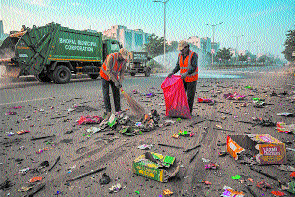
Under the plan, the Bhopal Municipal Corporation (BMC) will collect firecracker residue separately from normal household waste across all 85 wards. On average, the capital generates over 1,000 kg of hazardous cracker waste during Diwali, but last year’s post-festival drive proved the real load is far higher, BMC collected over 1,100 tonnes of total waste, of which nearly 20 tonnes was cracker waste alone.
Door-to-door collection vehicles will now carry a dedicated red bag and compartment for hazardous waste.
The material will be stored separately at garbage transfer stations and then transported in special covered containers by a contracted agency to the Treatment, Storage and Disposal Facility (TSDF) at Pithampur in Dhar district, 230 km away. Operational since 2006, the facility will treat the waste through high-temperature incineration and secured landfill.
Authorities have issued a strict warning: under no circumstances should cracker waste be burnt in the open or mixed with wet and dry waste.
The residue contains heavy metals like strontium, barium, copper and lead, which can leach into soil and groundwater, while half-burnt crackers pose a serious fire risk in garbage vehicles and dumping yards.
With Bhopal’s AQI rising from 203 on Diwali day to 316, in the ‘very poor’ category, the next day last year, the MPPCB, BMC, police and the district administration have joined hands. Smog guns and fogging machines will spray water on major roads and busy intersections, while all major water fountains will run round-the-clock to settle PM10 and PM2.5 particles. The action follows the National Green Tribunal’s (NGT) hearing on October 13, which sought compliance with Central Pollution Control Board guidelines and Supreme Court orders on regulated, green crackers only. Teams will also run awareness drives, urging citizens to keep cracker remnants separate.