Oman chose India over UAE for Chandrakar
| Date :03-Nov-2026 |
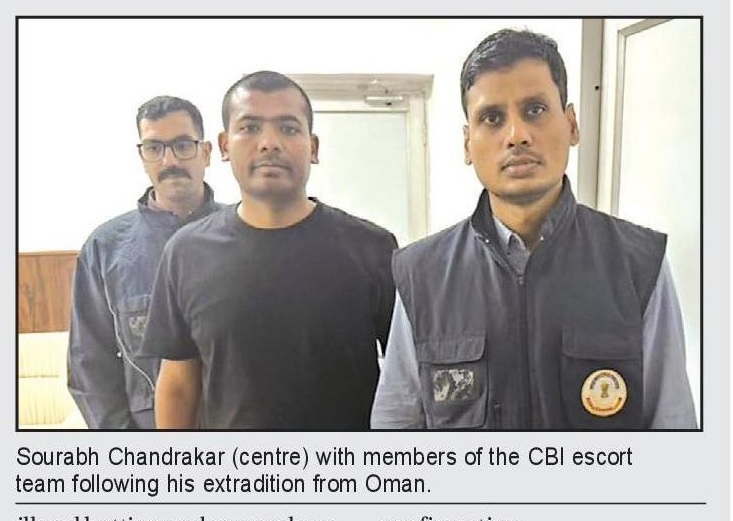
By Mukesh S Singh
RAIPUR,
- Muscat judges rejected Vanuatu citizenship defence after Indian Embassy confirmed nationality officially
- Separate Omani forgery proceedings initially complicated transfer despite ruling favouring Indian authorities
INDIA’S success in securing
the extradition of Sourabh
Chandrakar, alleged mastermind of the Rs 6,000-crore
Mahadev Online Book betting
syndicate, followed a contested
legal battle in Oman where the
United Arab Emirates (UAE) also
sought his custody. Indian
nationality, an earlier application and compliance with
Omani extradition safeguards
ultimately tipped the judicial
balance in India’s favour.
Chief Minister Vishnu Deo Sai
hailed Chandrakar’s return as a
major breakthrough, thanking
the Central Bureau of
Investigation (CBI) and other
Central agencies for their sustained efforts to bring him before
Indian courts.
The Hitavada exclusively
accessed a copy of the 12-page
judgment delivered by the
Muscat Court of Appeal on
October 8.
It explains why the
judges selected India over the
UAE and reveals a separate
Omani prosecution that initially prevented Chandrakar’s
departure.
The contest began with applications lodged
within 48 hours.
India’s request
reached the court registry on
July 12, 2026, followed by the
UAE’s on July 14. The court combined the proceedings and
applied Article 6 of Oman’s
Extradition of Criminals Law,
which allows judges to choose
between competing states by
considering nationality, the
location and gravity of offences,
application dates and treaty
arrangements.
The judgment identifies three
decisive considerations: India’s
application arrived first, the
Indian Embassy confirmed
Chandrakar’s nationality, and
Indian authorities supplied the
documents and assurances
required for surrender. The UAE,
by contrast, omitted mandatory undertakings. The judges consequently approved extradition
to India and
rejected Dubai’s
request, without
determining Chandrakar’s guilt.
India relied on its extradition
treaty with Oman, signed on
December 26, 2004, with ratification instruments exchanged
on September 14, 2005.
Its file included a September
4, 2023 non-bailable warrant
issued by the Special Court
under the Prevention of Money
Laundering Act (PMLA) in
Raipur, a Chhattisgarh Police
chargesheet, investigative material and statutory assurances.
The request concerned alleged
illegal betting and money laundering under Sections 3 and 4
of the PMLA in case
RPZO/10/2022.
The UAE’s request described
Chandrakar as a Vanuatu national, a classification sharply at
odds with the Indian Embassy’s
confirmation.
Chandrakar contested surrender to either country.
Through counsel, he claimed to
have renounced Indian citizenship in 2020 and acquired
Vanuatu nationality He questioned jurisdiction and documentary sufficiency,
and claimed to have been acquitted in the UAE in 2025.
The court recorded those submissions without accepting
them as grounds to refuse India’s request. On July 16, the
judges sought clarification from the Indian Embassy in
Muscat. Its diplomatic reply dated August 30 confirmed
Chandrakar remained an Indian citizen.
Rejecting his objection, the court held that even possession of Vanuatu nationality would not automatically prevent extradition where
statutory requirements were satisfied.
Under Article 11, India had undertaken not to prosecute
him for unrelated offences committed before surrender,
not to extradite him onward without Oman’s consent, and
to guarantee a fair trial with defence safeguards. The court
also found that the alleged offence occurred in India, met
Omani punishment thresholds and was supported by the
necessary warrant and evidence. Dubai’s application, under
the Riyadh Arab Agreement for Judicial Cooperation, concerned Criminal Case No 18483/2026, involving allegations
that money-laundering proceeds financed illegal organisations.
Although supported by an international arrest warrant, the UAE request lacked assurances limiting prosecution for other earlier offences, prohibiting onward surrender without consent and guaranteeing a fair trial. Those
omissions, alongside India’s earlier filing and confirmed
nationality, proved decisive.
India’s victory did not, however, authorise immediate surrender. The Muscat judges postponed extradition because
Chandrakar faced proceedings before the Seeb Primary Court
over an allegedly forged travel document used to enter and
attempt to leave Oman. Article 5 required completion of
that trial, a final judgment and execution of any penalty.
The October 8 order does not explain how the condition
was resolved before his November 1 transfer. Well-placed
sources at the Enforcement Directorate’s Raipur Zonal
Office (ED-RPZO), separately investigating the alleged betting network, indicated that the agency had monitored the
extradition proceedings alongside the CBI and other Central
authorities. “His return reflects sustained coordination
involving the Ministry of External Affairs, Ministry of Home
Affairs, CBI, ED and Omani authorities. With two CBI
chargesheets and an ED prosecution complaint already filed,
the focus now shifts from international legal proceedings
to the courts in Raipur,” the sources said.