Desperation of a dethroned prince
| Date :04-Nov-2026 |
By Deepika Bhan :
Rahul Gandhi’s mission seems to be focused on one objective: discrediting a legitimately elected Government. He seems to be in a hurry to reclaim something that he believes belongs to him. His recent political activities suggest an Opposition leader who is unwilling to accept the limitations of his present position. It is perfectly legitimate to seek a change in Government. But what Rahul Gandhi has been doing of late reflects what can only be described as the
desperation of a prince who has been dethroned. He seems more inclined towards discrediting others than proving his own worth.
RAHUL Gandhi
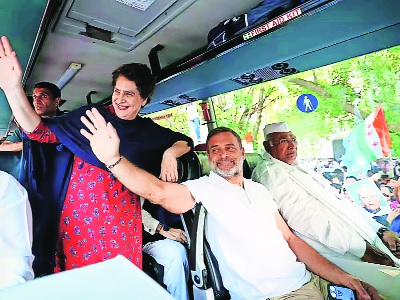
sitting in the front seat of an open bus, with other Opposition leaders behind him, and a man wearing saffron headgear running barefoot with a fluttering Tricolour; the scene could not have been more dramatic.
The Ramlila Maidan provided even more eye-catching moments, with thousands of people, mainly from Congress-ruled States, turning up to show solidarity on an issue that Rahul Gandhi wants to turn into a movement for regime change.
In an age when spectacles have become favourites on social media and the number of views and clicks matters so much, Rahul Gandhi’s event could certainly be termed interesting. But success in the virtual world is quite different from the ground reality.
The ground situation is not as rosy as the viral reels and social media posts might
suggest.
The recent MLC elections in 28 seats across four States offer a reality check. These were not elections fought in the illusory world of social media. The truth is that the Congress won just one seat, and that too largely because of the candidate’s own standing rather than any political appeal that Rahul Gandhi might have generated.
Earlier, during the Bihar elections, Rahul Gandhi tried his best to make the Special Intensive Revision (SIR) an issue but failed to get the response he was looking for.
he people voted in large numbers and handed victory to the Bharatiya Janata Party (BJP)-led NDA.
Then why is he sticking to this issue and trying to create a wave, believing that ordinary voters, who have been casting their votes, will buy his claims? The answer perhaps lies with Rahul Gandhi himself and those who were sitting in that open bus and attending his rally at the Ramlila Maidan.
Consider the leaders who have rallied behind him. Mamata Banerjee, who lost the West Bengal Assembly elections; the Left, which lost its hold in Keralam; Akhilesh Yadav, who is trying to regain his political foothold in Uttar Pradesh; Mehbooba Mufti, whose party suffered electoral setbacks in the Jammu and Kashmir Assembly polls; and Farooq Abdullah, whose party is grappling with internal discord. Then there are Sanjay Raut and Supriya Sule, whose respective parties lost power in Maharashtra.
Rahul Gandhi’s mission, and that of those supporting him, seems to be focused on one objective: discrediting a legitimately elected Government. With each passing day, this impression is becoming more apparent.
Rahul Gandhi seems to be in a hurry to reclaim something that he believes belongs to him.
Whether it is questioning the Election Commission, challenging electoral mandates, or organising a mock Parliament to target constitutional authorities, his recent political activities suggest an Opposition leader who is unwilling to accept the limitations of his present position. His stated political objective seems to be to dislodge the Government at the Centre, led by Prime Minister Narendra Modi.
He has identified his targets and made them known
publicly: CEC Gyanesh Kumar, Home Minister Amit Shah and Prime Minister Modi.
There is nothing wrong with criticising the Government or the ruling party. It is the Opposition’s job to question the Government, raise its voice and hold the ruling dispensation accountable. It is also perfectly legitimate to seek a change in Government. But in India, a change of Government can only come through the electoral process or a change in the political equations that sustain a coalition Government.
What Rahul Gandhi has been doing of late reflects what can only be described as the desperation of a prince who has been dethroned. Instead of focusing on getting his own and his party’s act together, he seems more inclined towards discrediting others than proving his own worth. Perhaps he believes that this kind of politics can help him create the wave among the masses that he has so far failed to generate.
Rahul Gandhi’s repeated attacks on constitutional institutions, even as he makes a show of carrying a
pocket-sized copy of the Constitution, are quite
paradoxical.
The Election Commission of India, the Supreme Court and the office of the Prime Minister are all important
pillars of our constitutional framework. They are certainly not above scrutiny or
criticism. But attempting to create mass hysteria through
allegations that have yet to be substantiated is hardly the way to demonstrate respect for the Constitution.
Interestingly, Prime Minister Modi made some striking remarks during his speech in Gujarat on ‘Rashtriya Ekta Diwas’.
He mentioned that certain forces were continuously engaged in conspiracies to divide the nation.
He said that attempts were being “made to divide and pit against one another the
children of Mother India”.
He also added that, after more than a decade of
frustration and disappointment, these people had now come out in the open.
“We must identify who is secretly meeting whom abroad, which anti-India forces are supporting whom, and who is speaking the
language of India’s enemies. We must recognise these
patterns. We must unite and confront them. Especially the way social media is being used as a weapon, the way rumours are being spread, and the efforts being made to damage India’s image, all
citizens must come together to deal with these challenges,” he said.
These are serious statements and point to concerns that have been expressed repeatedly by many.
If foreign elements are indeed involved in pushing agendas and creating instability in India, it is high time the Government exposed them and placed the evidence in the public domain.
Without naming anyone, PM Modi’s remarks offered enough hints to invite
questions.
Why have constitutional institutions, including the Election Commission, the Supreme Court and even the Armed Forces, repeatedly come under attack? Are these attacks merely part of
domestic political sparring, or is there a larger story that needs to be examined?
The Government must investigate and bring the facts into the public domain. After all, a dethroned prince may continue to dream of
reclaiming his throne, but in India’s democracy, it is the people who decide who gets to occupy it.
(IANS)
n