After Visarjan, Bhopal’s lakes show strain, but official data tells a mixed story
| Date :06-Nov-2026 |
Staff Reporter :
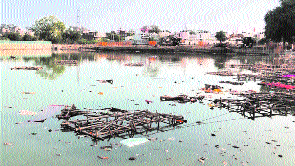
Bhopal’s lakes bore the familiar strain of Lord Ganesh and Maa Durga idols’ immersion this season, with pollution control officials recording a sharp rise in organic pollution, even as they insisted that oxygen levels in the water did not collapse.
According to the Madhya Pradesh Pollution Control Board (MPPCB), Biological Oxygen Demand (BOD), a key indicator of organic pollution, rose sharply after immersion, particularly in reservoirs on the city’s outskirts.
High BOD means micro-organisms are consuming more oxygen to break down organic matter, a sign that water is carrying a heavier pollution load.
The rise was steepest at Hathaikheda, where BOD was recorded at 7.2 mg/l before immersion, 13.2 mg/l during immersion, and 22.2 mg/l after immersion. At Prempura Ghat, it rose from 3.2 mg/l before immersion to 5.2 mg/l after. At Shahpura, it increased from 5.8 mg/l to 6.8 mg/l, and at Rani Kamalapati Ghat from 4.8 mg/l to 6.4 mg/l. Immersion was permitted at seven notified ghats, Prempura, Khatlapura, Rani Kamalapati, Bairagarh, Malikhedi, Shahpura and Hathaikheda.
Officials said immersion in temporary kunds and artificial ponds in urban areas helped prevent direct pollution of the main water bodies.
On dissolved oxygen (DO), the MPPCB’s reported position was that levels did not change significantly and remained around 4 mg/l in urban areas, a level officials described as almost
safe for aquatic animals. That assessment has been questioned by environmentalists, who argue that decaying Plaster of Paris (PoP) idols, chemical paints and puja offerings consume oxygen as they break down. The question of heavy metals remains unresolved.
One report said the Board had detected traces of zinc, chromium, copper, lead, cadmium and cobalt after immersion, linked to synthetic paints and PoP. Another account, quoting green activist Dr S C Pandey, said the MPPCB report was silent on heavy-metal levels, despite a 2013 National Green Tribunal direction to test for them after immersion. The Board has said rainfall during the festival, the use of kunds and a shift towards eco-friendly idols kept metal concentrations low. Ground reports, however, found PoP idols still being sold and immersed, and clay idols often coated with distemper, oil and wall paints. The MPPCB’s analysis of the subsequent Durga idol immersion was reported to be still underway. Officials have been asked to publish it, along with the full signed laboratory data, so the scale of post-festival damage can be assessed clearly.