Political rally holds city hostage
Date :06-Nov-2026
Staff Reporter :
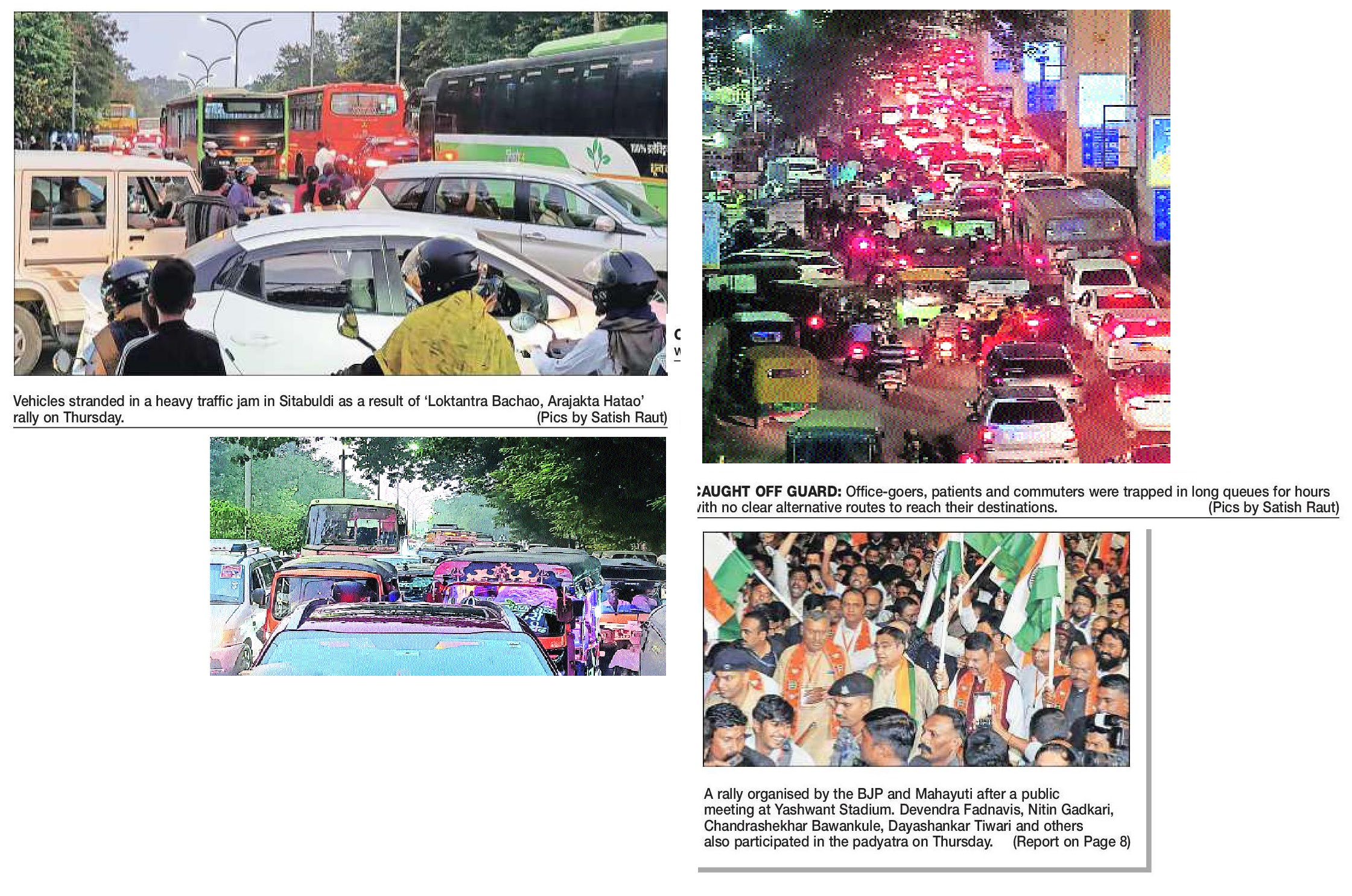
The heart of Nagpur came to a grinding halt on Thursday evening as thousands of Bharatiya Janata Party (BJP) supporters took to the streets for ‘Loktantra Bachao, Arajakta Hatao’ rally, bringing a large part of the city into a sprawling traffic gridlock.
What was meant to be a political show of strength from Yashwant Stadium in Sitabuldi to Samvidhan Square became an ordeal for thousands of ordinary citizens, with office-goers, patients and commuters left stranded for hours.
The rally, held during peak evening traffic hours, brought movement on several key roads to a standstill. With no adequate advance warning about road closures or traffic diversions, commuters returning from work were caught completely off guard.
Many found themselves trapped in long queues with no clear alternative routes to reach their destinations. The scale of the disruption was evident across the city centre.
Traffic queues stretched from Samvidhan Square on to Koradi flyover, extending well beyond NIT headquarters. Sitabuldi, Dhantoli, Ramdaspeth, Amravati Road and Canal Road witnessed severe congestion, with vehicles remaining virtually frozen for hours.
The disruption was not restricted to routine commuters. Several ambulances were also caught in the traffic snarls, raising serious concerns about consequences of blocking crucial city roads during an already congested period. With vehicles packed tightly and little room to move, emergency services faced the same bottlenecks as ordinary motorists.
Absence of effective traffic management and lack of proper public communication in advance made matters worse.
Citizens were not given adequate notice of the proposed route closures or diversions, leaving them with no opportunity to plan their journeys or avoid the affected roads.
The traffic police appeared unprepared for the scale of the gathering and its impact on the city’s road network.
As commuters struggled to find alternative routes, the congestion spilled into adjoining localities, creating a cascading effect. Roads in Ajni, Dharampeth and Sadar also witnessed heavy traffic as motorists attempted to bypass the affected stretch.
Instead of easing the situation, the diversion of vehicles into already busy neighbourhood roads further compounded the chaos. The choice of timing and route also raises questions.
The rally passed through one of the city’s busiest roads, which experience heavy traffic even on weekdays. Holding a large political procession during the
evening rush hour, without a clearly communicated traffic plan, placed an avoidable burden on public. Political parties have the right to hold rallies and demonstrate their strength.
However, that right cannot come at the cost of paralysing a city and making thousands of people bear its brunt.
The disruption on Thursday exposed serious gaps in traffic planning, coordination and public communication.