‘Fruits’ of their labour: Tribal women risk safety for livelihood
| Date :20-Feb-2026 |
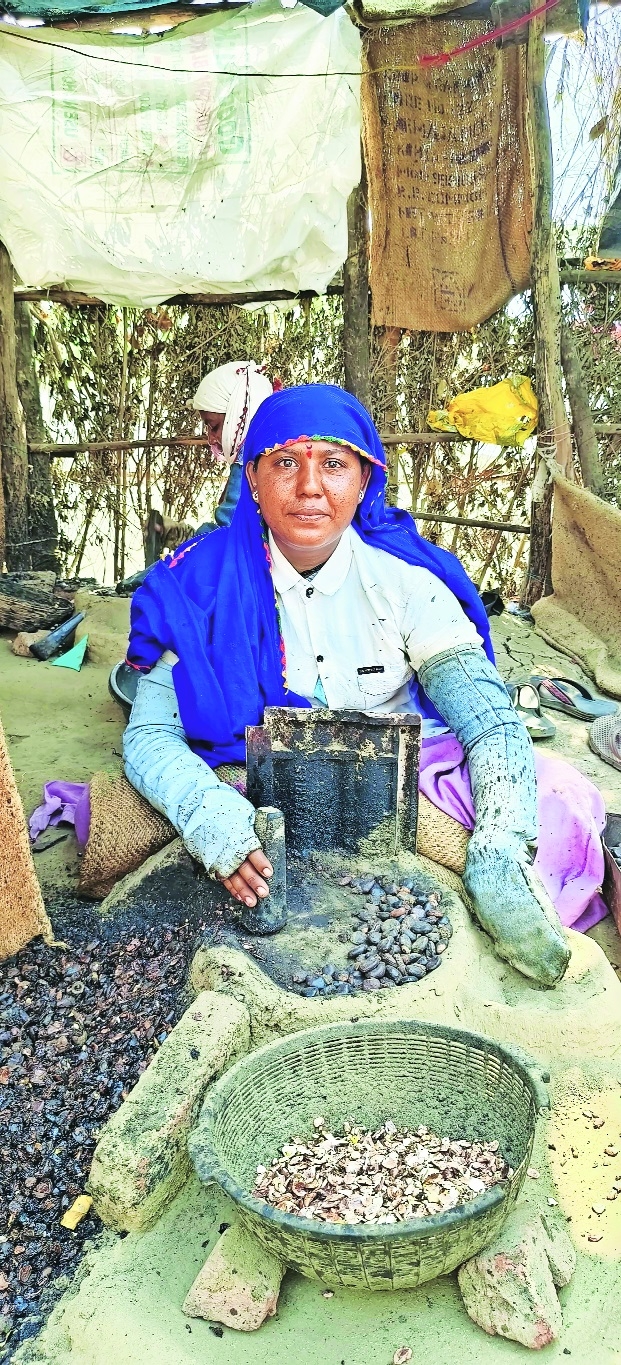
With little protective gear on, a women in Patur tehsil works on breaking biba nuts.
By Sachin Murtadkar :
Alegaon,
Before the hearth is lit at six in the morning, a hammer is already in their hands. In front of them lie hard, sharp shells of the marking nuts, also known as bhilawa or biba, and behind every strike hides the risk of injury. Fingers get crushed, oil splashes and burns their skin and the constant fear of permanent eye damage looms large. Yet, for Rs 250 a day, tribal women from Jam, Charmori and Pachran in Akola district break five kilograms of shells every day. Their hands continue to bear the scars of survival. In the tribal belt of Akola’s Patur taluka, employment opportunities are scarce and agriculture is insufficient.
There are no industries and wage labour is limited. In such circumstances, some traders bring biba from Madhya Pradesh and assign the shell-breaking work to local women.
To produce one kg biba, nearly five kgs of shells must be broken, for which the worker will receive Rs 250. The oil contained in these shells is extremely hazardous. If it comes in contact with the skin, it causes blisters, burns and wounds. If it splashes onto the body, it leaves painful marks and if it enters eyes, there is a risk of permanent damage.
Recently, a village worker, Saraswati Ambadas Pardhi, had to undergo surgery after shell oil splashed into her eye. Yet, with no alternative means of livelihood, she had to return to work, a reality that is even more painful. The workday of these women stretches for 12 hours from six in the morning. There are no protective measures, no gloves, no safety goggles. Everything is done in the open, with constant exposure to danger. Meanwhile, these marking nuts are sold in big cities as a dry fruit and spice ingredient at high prices, sometimes reaching thousands of rupees. However, the women who prepare them receive a meager wage. The stark disparity between the value of labour and the market price is evident.
Rekha Vinod Devkar says, “My husband’s both kidneys have failed. We have no farm and no other source of income. I have to do this work to meet medical expenses.”
The tears in her eyes and the wounds on her hands testify to her harsh reality.
It may be mentioned here that some 35 years ago, biba trees were found in the forests around Patur-Alegaon. However, large-scale deforestation led to their disappearance. As a result, raw material is now brought from outside. With local production stopped, women are left dependent solely on daily wages. Vimalbai Ramkrishna Jatale says, “There are no employment opportunities in the tribal region. Government should provide alternative livelihood opportunities.”
“Considering the risks involved in this work, providing protective gear and technical assistance is must to prevent accidents,” opined Shilpa Manoj Bhurkale.
The dangers these women face are real. While the fruit of their labour adds flavour to the plates of the wealthy, the bitterness in the lives of these women remains unchanged.