Of pioneering contribution to new-tech revolution
| Date :24-Feb-2026 |
By Vijay Phanshikar :
From Sanskaar at home at grand-father’s feet through his stories heard in childhood when his
imagination was honed to spiritual levels to becoming an integral part of a
multi-faceted revolution across domains, has been a truly long journey full of excitement, disappointment, celebration and cerebration. Today, after several decades of dedicated effort, he has occupied a critical place and space in what is globally described as ‘Orange’
revolution -- spearheading the creation of Creators’ Culture, certainly in India as well as in some other parts of the world.
Having travelled this long on a challenging and creative journey and having led an entirely innovative and
creative thought-process, is Ashish Kulkarni a pioneer ?
Possibly yes, but he may not like that epithet. No
matter that, his is the story of pioneering thought and
pioneering action for his dear Bharat -- to help propel it to pursue an idea of future, to create in the country an appropriate culture for AVGCXR -- Animation-Visual Effects-Gaming, Comics-Extended Reality -- a term coined by Ashish Kulkarni (and now accepted by the country).
It took much effort, of course, to convince the Government (of India) to accept the idea -- and also its ideology. But all that work made its effect. In 2021, the Ministry of Information and Broadcasting formed a Task Force with Ashish Kulkarni
on board.
The Task Force
recommended the creation of national policy and formation of a ‘Create In India Mission’. That reached home, so to say. And at the recent AI Impact Summit, I&B Minister Ashwani Vaishnaw announced that India would soon have its very own ‘Create In India Mission’ and would soon be a global leader in “Orange Economy” and
creators’ culture. In two
consecutive Union Budgets, the Government also had hiked allocation for this area. And in Union Budget 2026, it granted Rs 250 crore to launch Creators’ Labs in 15,000 schools and 500
universities across the
country.
That was a big leap into new times for the country seeking new pathways to
creative career choices for those who did not want
to pursue medical or
engineering or economics or finance or legal as
career-lines. Through the
new approach, youngsters now would be able to
pursue subjects such as
performing arts, creative arts, design, sports, earth sciences and enjoy equal opportunity in a better environment standing on a level-playing field. Discussions are afoot with all education boards to launch AVGCXR curriculum and teaching programmes from the 6th grade onward.
“I wanted that facility right from 1st grade, but that
could not be achieved”, Ashish Kulkarni says.
Is he the launcher of all these ideas personally? In some areas, yes. In some other areas, he made critical contribution. Old days are almost gone. Reading as an educational necessity is on the wane. The world of tomorrow -- or of even today -- will operate on 3 Vs -- Video, Voice, and Vernacular. Technology has made all this possible. This is essential to promote Creators’ Culture or Orange Economy as the world knows it. “This is an actual democratisation of learning opportunities in hitherto unavailable areas”, Ashish Kulkarni says, his eyes brimming with a legitimate pride of having been an integral part of the promotion of this culture.
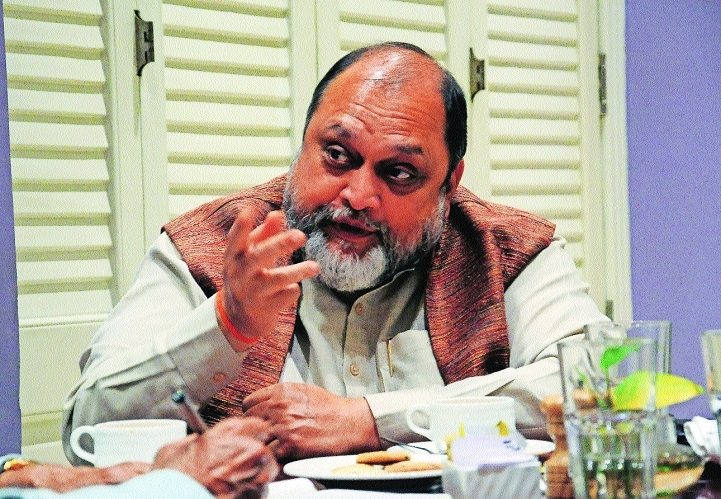
As he speaks, the voice of Ashish Kulkarni assumes a different pep, his eyes assume a different spark, his body language becomes all the more positive and his words tumble happily from his smiling lips.
Ashish Kulkarni recalls how as a youngster in Nagpur decades ago, he yearned to return home from play in the evening, eat the dinner, and then wait for his grand-father to start telling the kids at home stories from history and heritage. Those stories fired his -- and every child’s -- imagination, widened the scope of emotional comprehension. He also recalls how he got to learn so much from his young years in the Rotaract Club and the NCC. He still carries fond memories -- of his learning and maturing -- from his one year stay in Canada under a Youth Exchange Programme when he was just 19 years of age. He also played basketball as a Maharashtra player.
This facet of his personality defies the reality that you are talking to a person who has made signal contribution to national policy for New India’s younger generations and their creative talent. “It is my dream to give our youngsters newer and ever expanding opportunities for creativity. It is my dream -- and we are working for its fruition -- to see that every career line in performing arts or creative arts or sports or design has dignity that equals the dignity and importance of the careers such as medical or engineering or finance or legal,” Ashish Kulkarni adds with much verve.
Of course, the National Education Policy of 2020 allows all this thought and action. But way back in 1956 when the country got its first ever education policy, there were only limited pathways -- medical, engineering, finance and legal.
That old story is now over, and new story is unfolding. “I am happy, a lot of good things are happening -- though through much persuasion, much focused work for years,” he adds.
The younger generations desire and deserve dignity, status and hygiene for good life. They want to travel from mere service-providers to idea-creators. This may become more easily possible if education and skill-training are merged into one ministry for a better coordinated effort, Ashish Kulkarni asserts.
Through a White Paper on the subject, he urged the Government to create eco-system to restore traditional, performing, creative and folk arts and called for formation of an institute such as the IIT and IIM. The efforts bore fruits, and the Government green-signalled creation of the Indian Institute of Creative Technology -- of which Ashish Kulkarni became the founding Director. The IICT has its interim campus at National Film Development Corporation in Mumbai, but would soon have its own complete campus in Mumbai’s Film City.
Currently, Ashish Kulkarni is engaged in helping the Centre and the State Governments to have a proper policy. Several States like Maharashtra, Telangana, Kerala, Karnataka, Madhya Pradesh, Rajasthan have active policy on the subject. Several other states are engaged in the process of writing their respective policies in AVGCXR.
His personal journey to this point is as dramatic and poetic as any other. He worked as CEO or COO in top corporates in entertainment or advertising domains. He was always conscious of the quality of traditional artists who made those massive bill-boards painting cinema idols such as Rajanikanth or Kamaal Hasan.
One fine day, digital technology threw all those artists out of job. So, Ashish Kulkarni gathered as many as 72 artists and got them together in Bengaluru. It was with their help that he created his iconic animation films such as Little Krishna, Shaktimaan, Big Bees and more. For his entrepreneurial venture, he needed funds. So, he sold his house and supported his dream.
The personal story can go on and on through many chapters -- which are critical to his iconic career. But then, that will have to wait for another time. Those details would be as awe-inspiring as in any other story.