Organic green, brown cotton variety revived in Ngp distt
| Date :27-Feb-2026 |
By Rohit Pawar :
ICAR-CIRCOT has developed technology to spin good quality yarn of green and brown cotton, now apparels on cards; Dyeing may get eliminated with availability of coloured yarn
In a significant push towards sustainable agriculture and eco-friendly textiles, Nagpur district is emerging as the hub for cultivation and research of naturally coloured cotton, particularly green and brown varieties, further the market may soon see introduction of staple made from them.
Scientists at the Indian Council of Agricultural Research-Central Institute for Cotton Research (ICAR-CICR), Nagpur, have come up with new varieties of brown and green coloured cotton. The Institute is in talks with group of farmers in Vidarbha for introduction of the new varieties so that they can start growing the crops commercially.
Speaking to The Hitavada, Dr V N Waghmare, Director, ICAR-CICR said, “Commonly cotton lint is white but some cotton varieties bear colours. Naturally Coloured Cotton (NCC) is a naturally pigmented fibre that grows in shades of brown, green, tan, blue, black etc. ICAR-Central Institute for Research on Cotton Technology (ICAR-CIRCOT), Mumbai, successfully developed
technology to spin good quality yarn, though the cotton grown has short staple length.”
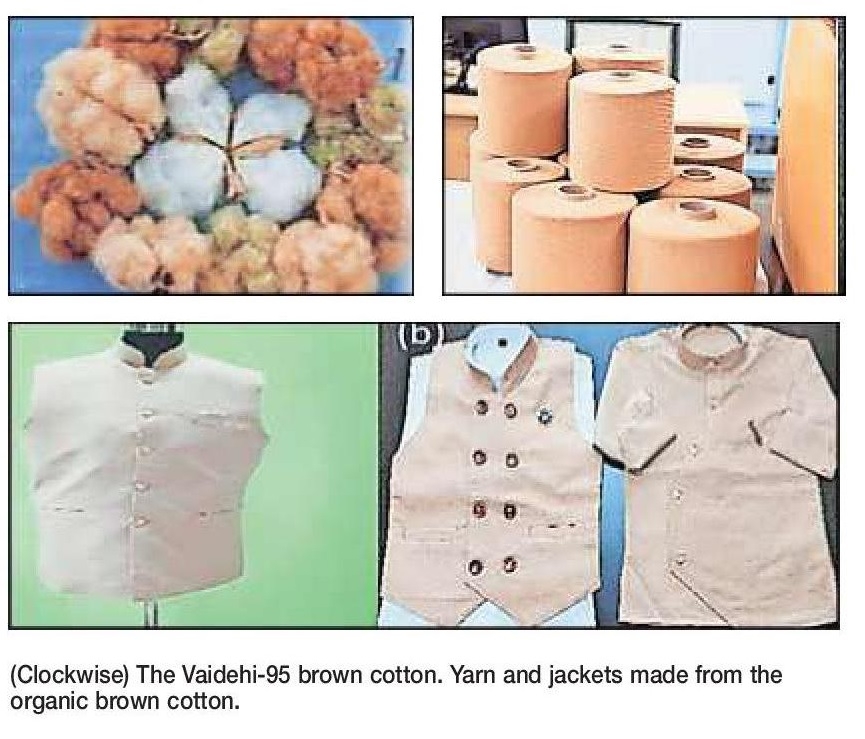
Dr Waghmare also added that various products from this fabric such as jackets, handkerchiefs and infant wears have been developed using NCC spun yarn by ICAR-CIRCOT; that makes these products 100 per cent chemical free with very high wash durability (due to inherent colour) and are also soft to feel and skin friendly.
As per the information, based on available genetic resources, experiments on additional natural colours may be possible in the future. If desirable traits are present within the germplasm or developed through mutation techniques new shades of naturally pigmented cotton could emerge.
According to the officials, registered cotton varieties, particularly cotton, are often not directly patented in India, as the Indian Patent Act (Section 3j) prohibits patenting plants and seeds. Instead, they are protected under the Protection of Plant Varieties and Farmers' Rights (PPVFR) Act, 2001. Researchers have identified two distinct shades in brown cotton - light brown and dark brown. Once the cotton boll bursts open, the effect of sunlight becomes clearly visible. Brown cotton tends to grow darker with increased exposure to sunlight, enhancing its richness of shade. Green cotton, although successfully developed, has yet to achieve colour stability. Its shade appears deep at the time of boll opening but gradually fades under continuous sunlight. Scientists are presently working to stabilise the green pigment while also improving fibre strength and staple length.
A major milestone has been the development of the brown cotton variety ‘Vaidehi Van’, created using wild cotton species. The variety took nearly 25 years of sustained research and selective breeding. Notably, its colour does not fade even after repeated washing, a characteristic considered essential for textile applications.
Importantly, all coloured cotton varieties developed, so far, are straight, non-hybrid types. This means farmers will not need to purchase new seeds every year. Once procured, seeds can be reused for several seasons and even shared with other cultivators, significantly reducing input costs and dependency on seed companies.
Experts believe coloured cotton could bring transformative change to the textile industry. At present, cotton undergoes a lengthy process from fibre to yarn, yarn to fabric, and finally chemical dyeing which increases both time and cost. Naturally pigmented cotton could reduce or even eliminate the dyeing stage, lowering production expenses and offering consumers comparatively affordable garments.
Conventional white cotton fabrics require chemical dyes that consume large quantities of water and release pollutants into soil and water bodies.
Dyeing is also an expensive stage in textile manufacturing. By minimising the need for synthetic colouring, naturally coloured cotton could reduce industrial pollution and operational costs.
While the research remains in its early stages, scientists describe the possibilities as extensive. For now, particular emphasis is being placed on strengthening and lengthening the fibre of green cotton to enhance its durability and commercial acceptance.