‘Civil’isation: Work in progress
| Date :01-Mar-2026 |
By Aasawari Shenolikar :
SINGING out loudly, trying to keep in sync
with the radio singer, I turned right from
Lokmat Chowk. Just as I turned, the traffic light turned yellow. I increased the
speed, and then braked hard. Right in
front was a yellow board that must have come up
during night, stating in bold letter, ‘DIVERSION’.
By this time, traffic from the opposite side had
started flowing, vehicles behind me formed a
queue and soon the situation turned chaotic. I
was struggling to maneuver my way into a constant flow of never ending traffic on a narrow
road that had turned narrower with the barricading.
I couldn’t find a spot to park and had to walk
half a kilometer from where I parked. And that
gave me ample time to process all that was going
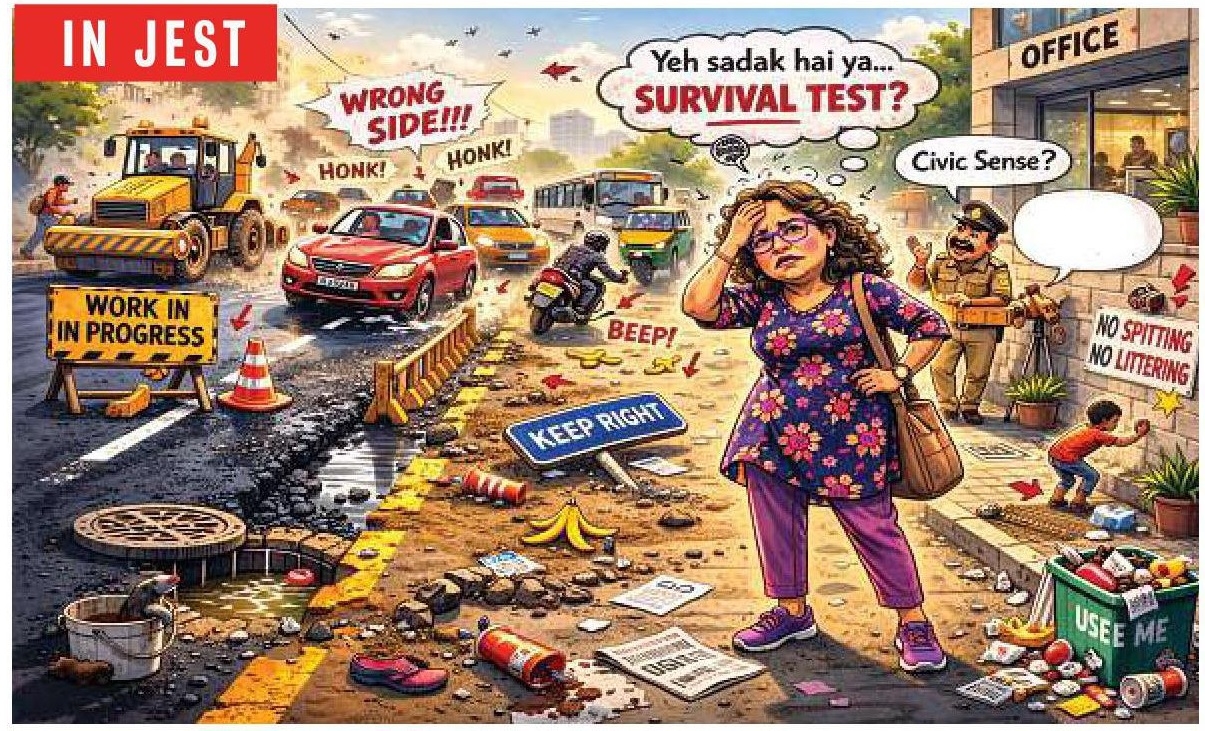
on. I noticed the road outside my office has suddenly developed an identity crisis. Half of it has
decided to reinvent itself - new surface, fresh tar,
big ambitions. The other half, at that point,
appeared battered, and sad - probably waiting
desperately for its turn for fresh tar. Mera number
kab aayega.
Between these two starkly different scenarios
lies the harsh reality - cloud of dust obscuring the
vision, making it difficult to breathe, the constant
honking from impatient drivers, and a level of
traffic confusion that put to shame the twists and
turns in any thriller.
We all are aware that Nagpur is a laid-back city,
and early working hours for them mean ten o’
clock or later. But naturally the road work begins
at the exact hour when everyone needs the road
the most. The machines, stationed there roar into
life with such vengeance as if they are here to
personally avenge every pothole complaint ever
made by citizens. The drilling begins. The grinding begins. The scraping begins. Overaperiod of
couple of days, after the work began, by the time I
reach my desk, I already feel like I have lived
through an action movie soundtrack - loud and
deafening.
But the real entertainment begins after that.
Because while half the road is being relaid, the
other half has turned into a universal solution for
everything - incoming traffic, outgoing traffic,
two-wheelers, cars, autos, pedestrians, and occasionally someone who seems to believe he is participating in a race.
And of course, in our country people drive on
the wrong side as if it’s their birthright.
Not a little wrong side. A confident, committed,
“I have chosen this path and I shall defend it”
kind of wrong side.
One morning, unable to resist the urge to play
responsible citizen, I raised my hand and stopped
a motorist who was advancing like a determined
salmon swimming upstream.
“Bhaiya, wrong side,” I said gently.
He looked at me with deep philosophical calm
and replied, “Bas thoda sa”.
In India, thoda sa is a very elastic concept. It
can stretch across lanes, roads, and sometimes
entire national highways.
(My better half, who was later apprised of this,
yelled at me, “This guy was decent. The next one
might just try to run you over. Why don’t you
mind your own business?” Me thinks it is this
very approach of Saanu Ki that has led to the current situations that we find ourselves in.)
Nearby stood two policemen watching this daily theatre unfold. I looked at them hopefully,
expecting perhaps a whistle, a raised hand, or at
least an expression of mild concern.
When I saw all was quiet on the police front, I
approached and pointed it out - just as a car was
rushing wrong side trying to zig zag its way
through the oncoming traffic.
One of them shrugged and said, “Logon mein
civic sense nahi hai.”
And that was that. Case closed.
I had to admire the honesty.
It was refreshingly
straightforward. Rules exist, signboards exist, barricades exist, policemen exist - but civic sense is
apparently sold separately.
Which made me think: perhaps this is our
greatest national superpower-our ability to
blame ‘people’ while simultaneously being those
very people.
I realise that I am not above fault - even as I am
complaining about traffic, I try to squeeze my
vehicle into a space that is just enough for a twowheeler.
So many of us criticise the system, but if we
see a shortcut, we do not hesitate for a moment
before going on the forbidden path.
Not giving heed to the rules and regulations
laid down by the authorities is not limited to
road sense alone. Look around you - on any
path, any locality and you will see how cleanliness -asubject very close to our collective
hearts goes for a toss. We discuss this in seminars, this is a favourite issue for campaigners,
and influencers post reels, sometimes on a daily basis, on social media posts, urging people
and authorities asking for accountability.
But on the ground, things get… creative.
Some throw garbage out of moving vehicles
with the casual grace of a cricket fielder returning the ball.
Some spit with the confidence of an artist
signing his work.
Some locate the nearest wall and decide it
has volunteered for a completely different
purpose.
And all the while, even as this is happening in
some part or the other, we complain about how
dirty the city has become.
It is a vicious circle of
avoiding responsibility.
The authorities, of course,
do their bit. They lay down
rules, install boards, paint
lanes, and occasionally issue
warnings. The law can punish, enforce, and regulate - but it cannot enter a
person’s mind and whisper, “Hey, you shouldn’t
be doing this.”
That part is entirely our department.
As I walk to the office, watching vehicles zigzag
across a half-constructed road, it suddenly struck
me that infrastructure development in our cities
has a two-fold character - it is as much an engineering challenge as it is a psychological experiment.
A well-laid road doesn’t necessarily promise
smooth, well-regulated traffic. We will still speed,
honk and do our best to ensure that the other
road users are harassed by our behaviour.
Sometimes we even take great sadistic pleasure in
it.
Of late the road infrastructure has improved -
we have to give the authorities credit where it is
meant to be given - lanes are marked, signals and
systems are in place (so what if half the cameras
and signals are not working) - but they only work
if people agree, collectively and quietly, that order
is a good idea.
Otherwise, chaos prevails, and like always we
adapt.
In fact, the half-relaid road outside my office
has become a perfect metaphor for civic behaviour. One half is new, planned, and hopeful. The
other half is familiar, unpredictable, and slightly
battered. And we, the citizens, move between the
two with remarkable creativity.
Every day the machines return, grinding and
levelling, determined to make the road smoother.
And every day we return, determined to test just
how flexible the concept of rules can be.
Perhaps that is why the policemen did not
seem surprised. They have probably seen this story unfold many times.
Road gets repaired. Traffic adjusts. People complain. People break rules. People blame people.
And life goes on - honking, spitting, shortcuttaking and all. Still, I remain optimistic. After all, if roads can
be relaid, perhaps civic sense can also be resurfaced one day.
Until then, we continue driving confidently on
the wrong side of progress - insisting, of course,
that it's only ‘thoda sa’.