Private vehicle boom tests city’s mobility plan
Date :16-Mar-2026
By Kunal Badge :
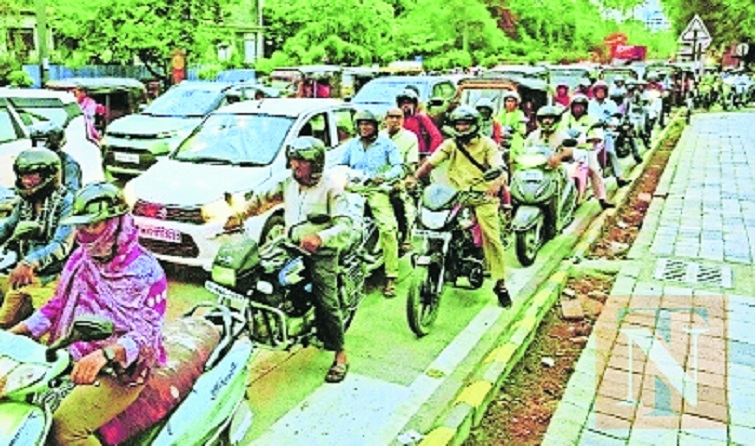
Nagpur’s attempt to reshape its urban transport system around metro rail, electric buses and integrated mobility planning is unfolding alongside a powerful counter-trend, a relentless rise in private vehicle ownership. While authorities are investing heavily in mass transit to reduce congestion and dependence on personal vehicles, the city’s rapidly expanding vehicle population is steadily filling its roads, posing a major challenge to the long-term success of the Comprehensive Mobility Plan.
Recent data indicates that vehicle numbers in the city have been rising sharply year after year.
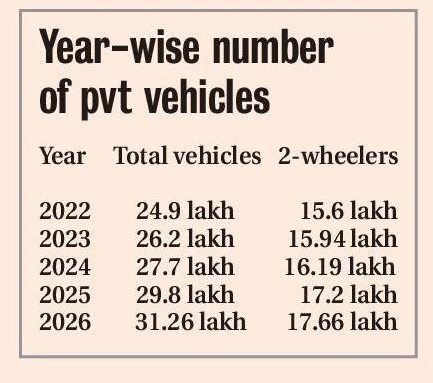
The city’s total registered vehicles have increased from about 24.9 lakh in 2022 to 31.26 lakh in 2026, adding more than 6.3 lakh vehicles in just four years. Two-wheelers alone account for the largest share of this expansion, growing from around 15.6 lakh in 2022 to 17.66 lakh in 2026.
The trend shows a steady annual increase, with nearly 1.5 lakh vehicles added between 2025 and early 2026 alone. According to Regional Transport Office data, the city now has more than 17.6 lakh two-wheelers and around 2.5 lakh cars, highlighting the growing
preference for private mobility among residents.
The growth is being driven by a combination of factors including rising household incomes, expanding suburbs and easy access to vehicle financing. As residential areas spread farther from traditional city centres, private vehicles are increasingly seen as the most convenient means of daily commuting.
The surge in Nagpur also reflects a broader statewide trend. Maharashtra’s vehicle population has grown from about 4.34 crore in 2022 to 5.28 crore by January 2026, according to successive Economic Surveys of the State. The addition of nearly one crore vehicles across Maharashtra during this period has placed mounting pressure on urban transport systems.
Yet the increase in private vehicles is occurring at a time when the city authorities are attempting to shift towards a more sustainable mobility framework. Metro rail services have already become operational in the city, and electric buses are gradually being introduced to modernise the public transport fleet.
The proposed Comprehensive Mobility Plan for the Nagpur Metropolitan Region seeks to integrate metro corridors, bus networks, improved road infrastructure and facilities for non-motorised transport into a unified system designed to reduce congestion and dependence on private vehicles.
Urban planners emphasise that strengthening mass transit, improving last-mile connectivity and deploying advanced traffic management systems are key elements of this strategy. The aim is to make public transport faster, more efficient and more convenient than private mobility.
However, transport experts caution that the continued surge in private vehicle ownership could dilute the benefits of these investments. If behavioural patterns remain unchanged and commuters continue to favour personal vehicles, the city’s expanding road network and transport infrastructure may struggle to keep pace with the rising number of vehicles.
The steady climb in Nagpur’s vehicle population therefore highlights a critical policy challenge. While the city is investing in metro rail, electric buses and integrated transport planning, the rapid expansion of private vehicles risks undermining the very effort to build a more sustainable and efficient urban mobility system.