‘2 top Iranian officials eliminated’
| Date :18-Mar-2026 |
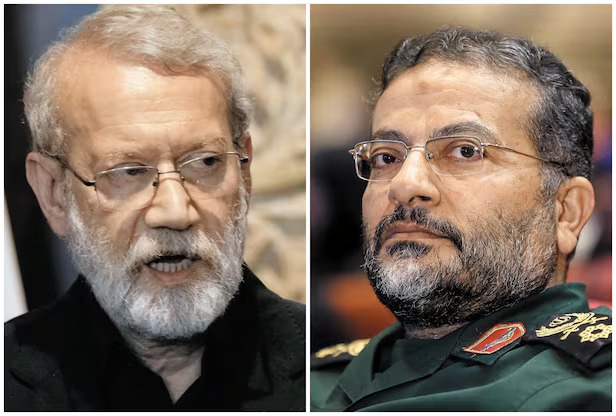
DUBAIRAN’S :
top security official and the head of the Revolutionary Guard’s Basij militia were both killed in overnight strikes in a blow to the country’s leadership, Israel’s Defence Minister said on Tuesday, while Tehran defiantly fired new salvos of missiles and drones at its Gulf Arab neighbours and Israel.
Both security official Ali Larijani and General Gholam Reza Soleimani were “eliminated last night,” Israeli Defence Minister Israel Katz said in a
statement. Iran’s 86-year-old Supreme Leader Ayatollah Ali Khamenei died in an airstrike February 28, the first day of the war launched by the United States and Israel, and other top leaders from the Iranian theocracy have been killed since then.
Iranian state media did not immediately confirm either death. However, it said a message from Larijani’s office would be published shortly.
The announcement came after the Israeli military had earlier said it had carried out a “wide-scale wave of strikes” across Iran’s capital and stepped up strikes on Iran-backed Hezbollah militants in Lebanon.
Israel also reported two incoming salvos before dawn from Iran at Tel Aviv and elsewhere, and said Hezbollah targeted Israel’s north.
Incoming Iranian missiles on the United Arab Emirates prompted Dubai, a major transit hub for international travel, to briefly shut its airspace and a man was killed by the debris of a missile intercepted over Abu Dhabi. Larijani hails from one of Iran’s most famous political families. A former parliamentary speaker and senior policy adviser, he was appointed to advise
the late Khamenei on strategy in nuclear talks with the Trump administration.
He also served as the secretary of Iran’s Supreme National Security Council, its top security body.
Soleimani, meantime, was the head of the Basij militia forces, which Israel’s military called an “armed apparatus of the Iranian terror regime.”
“During internal protests in Iran, particularly in recent periods as demonstrations intensified, Basij forces under Soleimani’s command led the main repression operations, employing severe violence, widespread arrests and the use of force against civilian demonstrators,” Israel’s military said in a statement.
The US Treasury lists Soleimani as having been born in 1965. He has been sanctioned by the US, the European Union and other nations over his role in helping suppress dissent for years through the Basij.
Killing Soleimani would likely further strain the command and control of the Basij, which would be crucial in putting down any uprising against the theocracy.
The Basij and other internal security forces have been a target of attack by both the Americans and the Israelis
so far.
Iran kept up the pressure on the energy infrastructure of its Gulf Arab neighbours, hitting an oil facility in Fujairah, a UAE emirate on the country’s east coast with the Gulf of Oman that has been repeatedly targeted.
State-run WAM news reported that no one had been injured in the blast from the drone strike.
The man killed by falling debris from an intercepted missile was the eighth person to die in the UAE since the start of the war, authorities said.
Iran’s attacks on Gulf nations and its grip on the Strait of Hormuz, through which a fifth of the world’s oil is transported, has given rise to increasing concerns of a global energy crisis.
Early Tuesday it hit a tanker anchored off the coast of Fujairah, one of about 20 vessels hit since Israel and the United States started the war with an attack on Iran on February 28.
Iran’s parliamentary speaker, Mohammad Bagher Qalibaf, said his country had been given no choice but to keep up its pressure on shipping traffic in the strait.
“They are flying, launching missiles, should we just sit back and do nothing in response?” he said in an interview on state television.
With Washington under increasing pressure over rising oil prices, Brent crude, the international standard, remained over USD 100 a barrel, up more than 40 per cent since the war started.
The UAE shut down its airspace early on Tuesday as its military reported it was “responding to missile and drone threats from Iran.”
The closure was soon lifted, and not long after the sounds of explosions could be heard as the military worked to intercept incoming fire.
The Israeli military early on Tuesday said it had launched new attacks across Tehran in addition to the Lebanese capital targeting Hezbollah militants.
In Iran, it said it hit command centres, missile launch sites and air defence systems.
There was no immediate confirmation from Iran, where little information has been coming out due to internet outages, round-the-clock airstrikes and tight restrictions on journalists.