Property Guidelines: Panel upholds hikes in premium pockets-based on market data, Proposal for ‘Maharashtra Model’ stamp duty reform to avoid ‘double taxation’
| Date :20-Mar-2026 |
Staff Reporter :
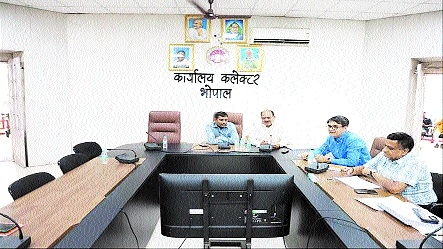
The District-Level Evaluation Committee, chaired by Collector Kaushlendra Vikram Singh, has maintained the proposed rate increases for several high-profile residential areas after a detailed analysis of actual market transactions. During a review of the 2026-27 property guidelines on Wednesday, the Committee dismissed pleas for rollbacks in certain premium colonies, citing evidence that current market values already justify the higher rates. A specific plea from Noor-us-Sabah Residency in Koh-e-Fiza to modify its proposed rates was rejected by the committee. Similarly, a request to roll back hikes in Golden City Jatkhedi was dismissed after an analysis of registered documents through the ‘Sampada’ portal confirmed that properties in the area are already being traded at higher values. Meanwhile, in peripheral locations like Deepdi on Bhojpur Road, the Committee noted that no hike had been proposed in the initial draft, effectively maintaining the status quo for that
sector.
Selective relief for developing residential zones
While the committee remained firm on premium pockets, it provided significant relief to other developing residential areas by scaling back proposed hikes following public objections. In a move favouring local residents, the committee partially accepted suggestions to reduce proposed rate increases for Alark Residency.
A similar approach was adopted for Bhauri, where the committee agreed to maintain current agricultural land rates, rejecting a proposed hike and keeping plot rates steady. Additionally, in Mayfair Colony (Ward 74), the Committee partially accepted suggestions to
align proposed rates with existing guideline categories, ensuring that property owners are not burdened by sudden, steep valuation changes.
Push for ‘Maharashtra Model’ to end double taxation
A major highlight of the deliberations was a proposal to modernise the State’s stamp duty structure, aimed at boosting market liquidity. Following a point-wise presentation by CREDAI Bhopal, the committee discussed adopting a system similar to Maharashtra for the re-transfer of property. Under this ‘Input Credit’ model, if a property is resold within a three-year window, the stamp duty paid during the previous registration would be adjusted against the new transaction.
South-West MLA Bhagwandas Sabnani strongly backed the proposal, noting that the current system of charging full stamp duty twice on the same property within a short period is neither practical nor justifiable.
By allowing this adjustment, the reform seeks to eliminate the unnecessary financial burden on citizens and businessmen, simplifying transactions and encouraging long-term investment in the real estate sector. The Committee has accepted the suggestion to be forwarded to the Central Evaluation Board and the State Government for formal consideration.
Data-driven revisions and future outlook
The 2026-27 guidelines are being finalized using advanced technological tools, including satellite-detected location changes to identify infrastructure growth.
This data-driven analysis revealed that in rural and semi-urban hubs such as Acharpura, Parvaliya, and Arvaliya, actual transactions are consistently occurring above the current government floor rates. Consequently, the committee accepted that an upward revision in these specific areas is necessary to reflect ground realities. The meeting concluded with the Collector indicating that one final session will be held to formalise the
guidelines before they are
officially notified.