State asks Discom to create of total electricity demand by 2035-36
| Date :20-Mar-2026 |
Staff Reporter :
- Maharashtra Renewable Energy and Energy Storage Policy projects surge in power demand to 350 billion units in next 10 years
- Power in the BESS can be injected in grid during peak evening hours to prevent any shortage
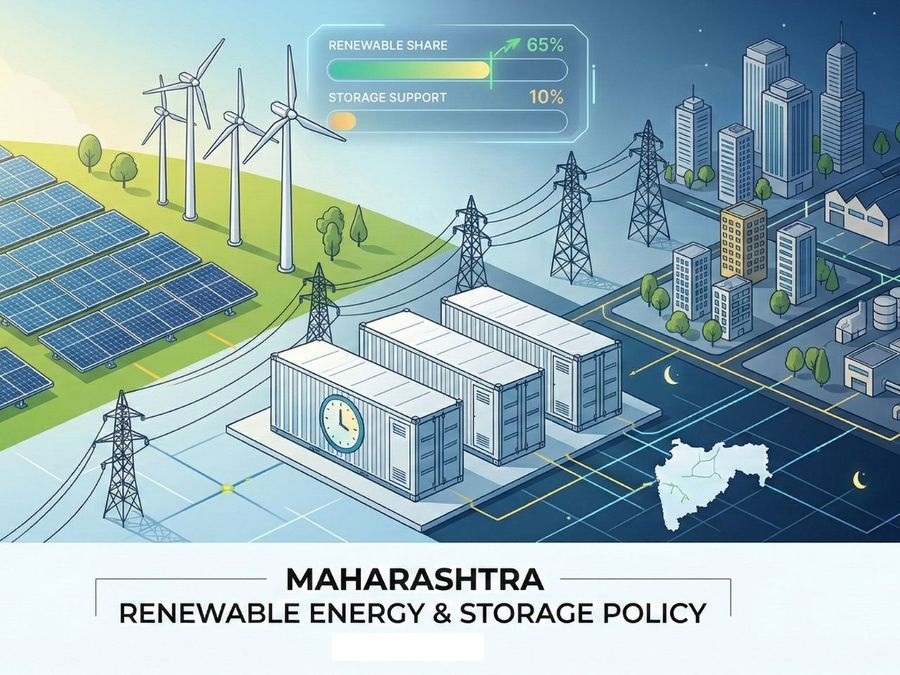
The newly-unveiled Maharashtra Renewable Energy and Energy Storage Policy for 2025-26 to 2035-36 period lays thrust on scaling up the Battery Energy Storage System (BESS), mandating distribution companies to put in place 10 per cent of the total expected demand capacity. Spelling out the reason, the policy unveiled by the Energy Department, estimated that, by year 2030, power demand in the State is expected to reach around 260-270 billion units and ultimately 350 billion units by 2035.
So, scaling up traditional power resources would not be enough whereas renewable energy would meet 50 per cent of total power demand in State by year 2030.
Another reason for encouraging creation of Energy Storage is State decision to procure about 65 per cent of its total expected power demand through renewable energy sources.
Further, Maharashtra Electricity Regulatory Commission (MERC) has stipulated Maharashtra State Electricity Distribution Company Limited (MSEDCL) that, by 2030, its Renewable Energy Purchase Obligation and Energy Storage Obligation should be around 43.3 per cent and 4 per cent respectively of the total power demand in State. Thus, State incorporated Energy Storage concept for the first time in the Energy Policy as it has mandated putting in place mechanism to store excess renewable energy generated during the day time. Same can then be leveraged during the peak evening period. The challenge with thermal power stations, it still forms bulk of power generation in State, is that units cannot step down generation as per demand as same could end up damaging them. But, maximum renewable energy is generated mostly during the day time, when the demand is on lower side. In evening, the real problem arises as demand shoots up considerably and supply falls short and thus, the Energy Department hopes to capitalise on stored power to balance the grid. At present, the Energy Storage units required very big investment and lot many clearances would be needed for integration with State grid.
Therefore, the policy tried to clear out the steps so that, within next few years, as domestic manufacturing capacity takes off, the energy storage grid can take effect.
The policy document relies on the national data wherein by 2030, Central Government has targeted achieving 500 GW of renewable energy generation. Alongside by year 2070, India expects to achieve reach net zero emission and hence, the State Government is giving thrust to tapping renewable energy as, by 2030, the carbon emissions are targeted to be cut down by 45 per cent compared to 2005 figures. Therefore, Central Government is incentivising renewable energy production as it has targeted achieving 50 per cent power generation through renewable energy. A review of past power demand and total generation in State reveals that between 2015 to 2020, renewable energy generation reached 12.5 GW, it was 12.5 per cent of the total energy production capacity. Now, by March 2025, the State saw the power demand reach 30.7 GW and in 2020, it was 20.4 GW. So a cursory look reveals that, the power demand has risen by nearly 50 per cent. Similarly, in 2014-15, a total of 133 billion units of power was supplied, which has now increased by nearly 52 per cent by 2024-25.