Airstrikes hit Iran capital, Tehran targets Israel, Gulf States, Mixed signals over talks to end war
| Date :25-Mar-2026 |
DUBAI :
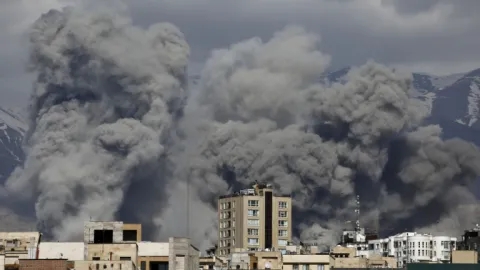
AIRSTRIKES battered Iran’s capital and Iranian missiles and drones targeted Israel’s Tel Aviv and sites across the Mid East on Tuesday, even as President Trump said the US was in talks with the Islamic Republic to end the war.
With thousands more United States Marines on their way to the Gulf, both sides firing intense barrages and Iran denying any negotiations are taking place, the war’s tempo remained high a day after Trump delayed his self-imposed deadline for Iran to reopen the Strait of Hormuz.
Tehran’s chokehold on that crucial waterway has snarled international shipping, sent fuel prices skyrocketing, and threatened the world economy.
Any talks between the US and Iran - which appeared at the most tentative on Tuesday - would face monumental challenges.
Many of Washington’s shifting list of objectives - particularly over Iran’s ballistic missile and nuclear programmes - remain difficult to achieve.
Meanwhile, it’s not clear who in Iran’s Government would have the authority to negotiate - or be willing to, particularly as Israel has vowed to continue taking out leaders after killing several. Israeli Prime Minister Benjamin Netanyahu, meanwhile, said Israel will continue to strike Iran and Lebanon even as the US considers a ceasefire.
“There’s more to come,” he said. Iran also remains highly suspicious of the United States, which twice, under the Trump administration, has attacked during high-level diplomatic talks, including with the February 28 strikes that started the current war.
Iran’s military has conducted strikes on the orders of local commanders, rather than from the political leadership, Foreign Minister Abbas Araghchi said early in the war.
It remains unclear whether Iran’s new Supreme Leader, Mojtaba Khamenei, who reportedly was wounded and has yet to be seen publicly, is issuing orders to Iran’s regular military or its paramilitary Revolutionary Guard, which answered only to his late father.
Mixed signals on negotiations amid deep mistrust
While Iranian Parliament Speaker Mohammad Bagher Qalibaf called the idea of negotiations with the US “fake news,” Araghchi’s office acknowledged the foreign minister has been talking about the war this week with his counterparts in Azerbaijan, Egypt, Oman, Pakistan, Russia, South Korea, Turkey and Turkmenistan.
Talk of negotiations briefly drove down oil prices and boosted stocks. But that respite was short-lived, with the price of Brent crude, the international standard, nudging back over USD 100 a barrel on Tuesday, up nearly 40 per cent since the war started.
Iran’s leaders are wary of Washington’s motives, in part because Tehran was in negotiations with the US before the surprise attack that started the current war. Iran was also in talks last year when the US and Israel attacked its nuclear facilities.
Iran hits Israel and Gulf neighbours while Israel attacks Beirut As airstrikes hit Tehran, Iran fired multiple waves of missiles at Israel early on Tuesday.
In Tel Aviv, a missile with a 100-kilogram (220-pound) warhead evaded Israeli defences to slam into a street in the centre of the city, blowing out windows of a neighbouring apartment building and sending smoke billowing. Four people suffered minor wounds, rescue service worker Yoel Moshe said.
In Kuwait, power lines were hit by air defence shrapnel, causing partial electricity outages for several hours. Missile alert sirens sounded in Bahrain, and Saudi Arabia’s Defence Ministry said it had destroyed 19 Iranian drones targeting its oil-rich Eastern Province.
Israel pounded Beirut’s southern suburbs on Tuesday, saying that it was targeting infrastructure used by the Iran-linked Hezbollah militant group.
A strike on a residential apartment southeast of the Lebanese capital killed at least three people, including a 3-year-old girl, according to the Lebanese Health Ministry. Another five people were killed in the south.