FUEL FRENZY Citizens crowd petrol pumps fearing shortage; administration urges restraint
| Date :25-Mar-2026 |
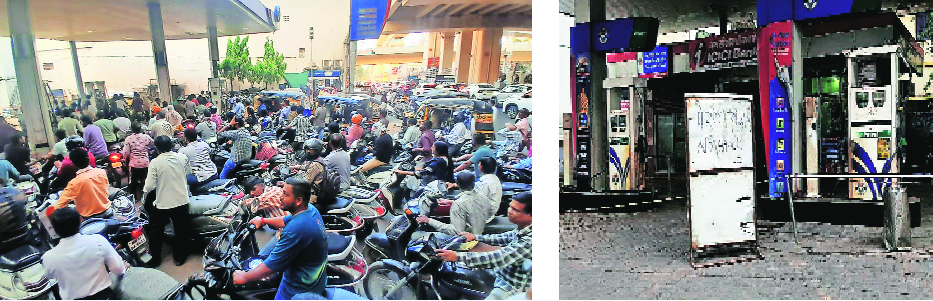
Citizens queued up at petrol pump at Agrasen Square fearing possible fuel shortage in future. Subsequently, many petrol pumps exhausted their stocks and were forced to shut by evening on Tuesday. (Pics: Satish Raut)
By Team Hitavada :
Despite repeated assurances from the district administration regarding adequate fuel availability, residents across the city rushed to petrol pumps on Tuesday, leading to unprecedented scenes of congestion and anxiety. Petrol pumps in nearly every part of the city witnessed long, snaking queues of vehicles, with traffic spilling onto adjoining roads and disrupting normal vehicular movement.
What began as a scattered concern over the past two days escalated into a full-blown panic buying, as rumours of fuel shortages spread rapidly among citizens.
By Tuesday morning, several petrol pumps had already begun experiencing heavy inflow, which only intensified as the day progressed. Prominent fuel stations, including the Indian Oil outlet at Samvidhan Square, Jio BP Petrol Pump in Raj Nagar, Bharat Petroleum pump at Byramji Town, HP Petrol Pump at Agrasen Square, among others, resembled crowded marketplaces, with motorists waiting for extended periods to refuel their vehicles.
The situation deteriorated further during evening peak hours, when demand surged sharply. Several petrol pumps reportedly exhausted their available stock and were forced to shut operations earlier than usual. Notably, the HP petrol pump in Sadar, which typically operates round-the-clock, was compelled to close in the evening due to depleted reserves. Similar closures were observed at the Bharat Petroleum pump in Shankar Nagar and the HP outlet at Dosar Vaishya Square. In an attempt to manage the crisis, some operators imposed limits on the quantity of fuel dispensed per vehicle, aiming to extend their available stock for as long as possible.
Industry experts attributed the sudden surge in demand to a combination of logistical and behavioural factors.
A recent change in advance payment procedures by oil companies has reportedly increased the turnaround time for fuel delivery from depots to retail outlets. This, coupled with intervening bank holidays and minor technical delays,
contributed to temporary disruptions in the supply chain. However, experts maintained that there is no actual shortage of fuel at the systemic level.
“The supply remains consistent, but the process has changed,” said Amit Gupta, President of the Federation of Petrol Dealers Association. “Earlier, dispatches were initiated alongside payment processing. Now, fuel tankers are dispatched only after payments are received, which has added to delivery time. This is being misinterpreted as a shortage.” He further emphasised that the situation has been aggravated primarily by excessive and unnecessary purchasing by consumers.
District Collector Dr Vipin Itankar reiterated the administration’s stance, urging citizens to remain calm and refrain from hoarding fuel. “There is sufficient stock available, and the situation is being closely monitored. Panic buying will only create artificial shortages and inconvenience for everyone,” he stated, echoing similar appeals made a day earlier.
However, these assurances have done little to quell public anxiety. Many citizens expressed scepticism, citing past experiences where essential commodities became scarce despite official reassurances.
“We were told there would be no shortage of LPG cylinders earlier, but later we had to buy them in the black market at inflated prices. I do not want to take that risk again,” said Sanjay Gajbhiye, a resident waiting in queue at a fuel station.
Others pointed to broader geopolitical concerns as a factor influencing their decisions. “With global tensions like the US-Iran conflict, there is uncertainty about fuel supply and pricing. If others continue to stock up, it is safer to fill up now rather than face difficulties later,” said Vishal, another commuter.
Authorities have also flagged the role of misinformation in fuelling the panic.
As the situation unfolds, the contrast between official assurances and public perception remains stark. While authorities and industry stakeholders insist that supply chains are intact and stabilising, citizen behaviour continues to be driven by uncertainty and mistrust. Unless the panic subsides, experts caution that the city may continue to witness such scenes of chaos, not due to scarcity, but due to fear itself.
GDKF demands strict SOP implementation
The Grahak Dakshata Kalyan Foundation (GDKF) has urged authorities to take strong action against hoarding and black marketing. It demanded strict SOP implementation, mandatory signboards at wedding venues warning that use of domestic gas cylinders is a crime, and surprise checks by flying squads. President Nitin Solanke called for strict MRP control to stop overpricing. Additionally, it stressed the need for proper security arrangements at overcrowded fuel stations to manage traffic and ensure smooth supply for consumers.
Misleading social media posts inciting panic-buying
According to the district administration, several misleading posts circulating on social media have falsely claimed that petrol prices could surge beyond Rs 500 per litre and that fuel stations may shut down in the near future. These rumours, officials believe, have significantly contributed to the surge in demand.
The administration has appealed to citizens to verify information through official channels and avoid acting on unverified claims. Officials warned that continued panic buying could strain local distribution systems, creating avoidable disruptions despite adequate supply at the macro level.