Women at forefront of water equity; panel highlights gender divide in rural parts
Date :25-Mar-2026
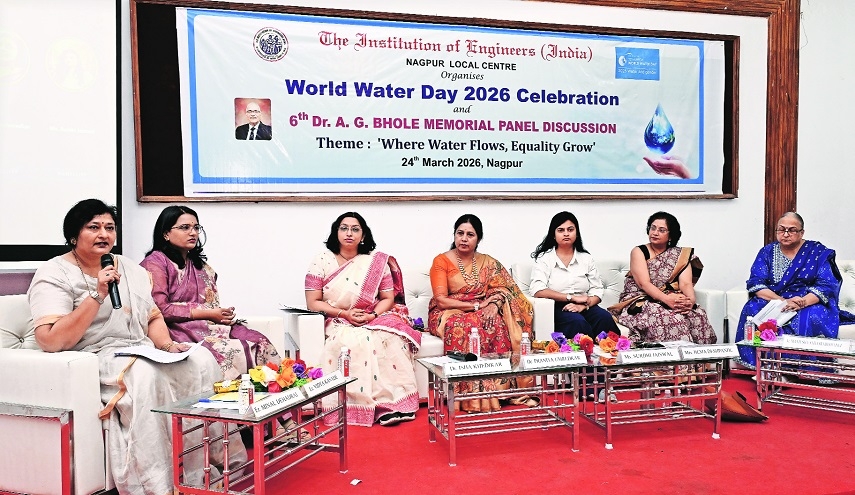
Minal Dehadrai with panelists Vidya Kanade, Dr Isha Khedikar,
Dr Pranita Umredkar, Surbhi Jaiswal, Hema Deshpande and Manjusha Sahasrabhojanee. (Pic by Anil Futane)
Staff Reporter :
Institution of Engineers, Nagpur celebrates World Water Day-2026
“Currently, the biggest irony is that girls in rural parts still bear the primary responsibility of fetching water. If we ensure adequate water supply in villages, they can instead utilise that time to study and progress,” said Dr Ramesh Daryapurkar, Convener, IEI, Maharashtra State Committee, Environment Engineering Division, at a panel discussion organised by the Institution of Engineers (India), Nagpur Local Centre, on the occasion of World Water Day. His remarks underscored the central theme, “Where water flows, equality grows”, focusing on how water scarcity continues to reinforce gender inequality in rural India.
The panel brought together experts from engineering, urban planning, environmental governance and social sectors. Vidya Kanade, Executive Engineer, Maharashtra Jeevan Pradhikaran, stressed the importance of efficient infrastructure and suggested pressure-lowering mechanisms in taps, which can reduce water consumption by up to 50 per cent.
Manjusha Sahasrabhojanee, Urban Planner and Architect, highlighted that even where water supply exists, poor maintenance of storage tanks and irregular supply to toilets remain persistent issues. She advocated for greater involvement of women in maintaining village water systems to ensure accountability and sustainability.
Dr Isha Khedikar, faculty of G H Raisoni College of Engineering and Secretary of the Indian Water Works Association, Nagpur, recommended water metering to curb misuse. She noted that rural communities tend to be more cautious in water usage compared to urban populations, where wastage is higher due to the perception of water being freely available.
Hema Deshpande, Regional Officer, Maharashtra Pollution Control Board, emphasised the need for awareness regarding water quality. She pointed out that many people still lack knowledge about safe drinking water, making pollution control efforts crucial.
Surbhi Jaiswal, Team Lead, Green Vigil NGO, linked climate change and environmental degradation to worsening water scarcity and gender inequality. She explained that declining groundwater levels force women to travel longer distances. She also highlighted a successful initiative where nearly 1.5 lakh Ganesh idols were immersed in eco-friendly tanks during Ganesh Chaturthi last year, preventing pollution of rivers and lakes.
Dr Pranita Umredkar, General Manager, Nagpur Smart and Sustainable City Development Corporation Ltd, stressed that government efforts must go beyond technology to include awareness and training programmes, particularly for women, to bridge the digital divide in water management.
The session was moderated by Minal Dehadrai, Director, Aquades Structural Consultants Pvt Ltd, who steered the discussion towards practical solutions for achieving water equity and gender justice.
Mahesh Shukla compered and Jayant Joshi, Secretary, IMI, Nagpur, concluded the programme with a vote of thanks.