Raipur Police dismantle cyber fraud racket, 42 arrested
| Date :27-Mar-2026 |
Staff Reporter
:
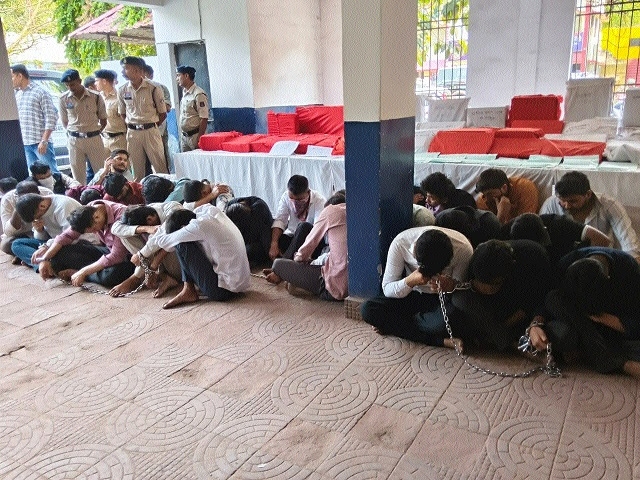
In a major intelligence-led operation, the Raipur Commissionerate dismantled an illegal call center network involved in international cyber fraud, arresting 42 accused persons from three locations
across the city.
The operation, conducted on March 25, 2026, exposed a
highly organised racket targeting foreign nationals, primarily in the United States.
The joint action by the Anti-Crime and Cyber Unit along with Ganj and New Rajendra Nagar police teams led to raids at Pithaliya Complex in Subhash Nagar and Anjani Tower in New Rajendra Nagar.
During the raids, 42 individuals were apprehended and electronic equipment worth
Rs 16.53 lakh was seized, including 67 mobile phones, 18 laptops, 28 computer systems, and three Wi-Fi routers.
Those arrested in the Ganj police station case include Anil Kumar Yadav alias Rohit Yadav, Saurabh Rajput, Abhishek Sharma, Rohit Sharma, Sonu Kumar Bharti, Rahul Prajapati, Mayur Khadpe, Nitesh Gurung, Ajay Chaudhary, Aditya Kumar, Sagar Kayastha, Nikhil Kshatriya, Chunna Patel, Mohammad Altamas, Vishnu Kushwar,
Ribh Raj, Dinesh Lalwani, Aniket Dubey, Kajal Acharyaji, Prakash Dwivedi, Deep Singh Yadav, Satyam Tiwari, Mohammad Gufran Hussain, Om Kodhavale, Rajendra Singh Jala, Shah Aman, Raj Dwivedi, Shivam Pandey, Rishabh Yadav, Karan Parmar, Aman Pandey, Rohit Kumar Chanchal, and Devesh Dwivedi.
In the New Rajendra Nagar police station case, the arrested accused are Gaurav Yadav, Abhishek Rajput, Amarendra Rajput, Gurpreet Singh, Manish Pal alias Monu, Pratap Singh, Ajay Singh Rajput, Rakesh Rajbhar, and Uttam Dubey.
Police revealed that the racket was being run by supervisors Rohit Yadav, Gaurav Yadav, and Saurabh Singh, under the direction of masterminds based in Gujarat.
The accused, hailing from multiple states including Gujarat, Uttar Pradesh, Rajasthan, Bihar, Meghalaya, Haryana, and Punjab, were recruited on fixed salaries with additional commission incentives tied to the fraud proceeds.
The gang operated through a structured, multi-phase system. Initially, a calling group procured data of individuals in the United States through platforms such as WhatsApp and Telegram and contacted them with offers of easy loans or assistance in improving CIBIL scores. Once victims engaged, their banking details were collected and circulated internally.A technical group then created forged checks using these details and deposited them into victims’ accounts. Exploiting a loophole in foreign banking systems where small deposits are provisionally credited before verification, the accused created a false impression of legitimacy.
Subsequently, victims were informed that their CIBIL scores had been improved and were asked to return the deposited amount via gift cards such as Apple, Google, and Amazon vouchers. These gift cards were then converted into cash by another group operating across India and abroad, including China.
The final proceeds were transferred through hawala channels to the masterminds, ensuring minimal traceability. The accused also used fake documents and forged arrest warrants to intimidate victims and coerce them into making payments.
During the raids, police recovered scripts, forged documents, and digital tools used in the fraud. The accused admitted their involvement, stating they were aware of the illegality but continued due to the lure of easy money.
Cases have been registered under relevant sections of the Bharatiya Nyaya Sanhita and the Information Technology Act at both Ganj and New Rajendra Nagar police stations. Further investigation is underway to trace the masterminds and uncover the full extent of the international network. Cases against the accused has been registered at Ganj Police Station, under Sections 61(2), 112(2), 316(2), 318(4), 319(2), 336(3), 337, 338, 340(2) of the BNS, and Sections 66(C), 66(D) of the IT Act; and Crime Case No. 131/26 at New Rajendra Nagar Police Station, under Sections 61(2), 112(2), 316(2), 318(4), 319(2), 336(3), 337, 338 of the BNS, and Sections 66(C), 66(D) of the IT Act.