Govt cuts excise duty on petrol and diesel Slaps windfall tax on fuel exports
| Date :28-Mar-2026 |
NEW DELHI :
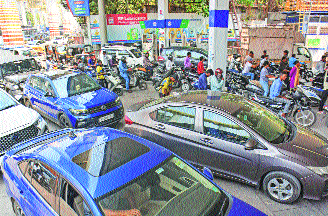
THE Government cut excise duty on petrol and diesel by Rs 10 per litre each, but retail prices will remain unchanged as refiners offset the reduction against higher input costs.
The reduction averts an increase in petrol and diesel price that had become necessary in view of rise in international oil prices by about 50 per cent in the last one month.
The cut in special additional excise duty on petrol from Rs 13 to Rs 3 per litre and on diesel from Rs 10 to zero will not lead to any change in retail pump prices as the reduction will be offset against fuel losses -- estimated by Oil Minister Hardeep Singh Puri at Rs 24 per litre for petrol and Rs 30 for diesel, and by his ministry at Rs 26 and Rs 81.90, respectively.
Alongside, the Government imposed an export duty of Rs 21.50 per litre on diesel and Rs 29.50 per litre on aviation turbine fuel (ATF), reinstating a levy first introduced in July 2022 to curb windfall gains by refiners following Russia’s invasion of Ukraine and later withdrawn in December 2024.
However, unlike last time, there is no windfall tax that has been levied on domestically produced crude oil by firms like ONGC.
Prices of crude oil -- the raw material for making petrol and diesel -- have gone up from around USD 70 per barrel before the start of the conflict in the Middle East to over USD 100, said Sujata Sharma, Joint Secretary in the Ministry of Petroleum and Natural Gas.
“The Government had two options -- pass on the increase to consumers (by way of an increase in petrol and diesel prices) or take a hit (by cutting excise duty). The Government chose the latter,” she told reporters.
Fuel prices in India have remained largely unchanged since April 2022 despite geopolitical shocks -- from the Russia-Ukraine war to the Middle East crisis -- that have driven sharp swings in global oil prices. The country depends on imports for 88 per cent of its crude oil needs.
In contrast, fuel prices have risen by 30-50 per cent across South and Southeast Asian countries, 30 per cent in North America, and 20 per cent in Europe since the onset of the current crisis.
CBIC Chairman Vivek Chaturvedi said the windfall tax on exports will result in a gain of about Rs 1,500 crore in the first fortnight while the Government will have to forgo over Rs 7,000 crore in revenue because of the excise duty cut. Explaining the rationale for levy of the export tax in form of a special additional excise duty (SAED), he said the surge in international prices had created an incentive for refiners to export and this move will help make available fuel for domestic consumption.
Sharma said, the 2022 requirement for refiners to sell 50 per cent of petrol exports and 30 per cent of diesel exports in the domestic market remains in place.
Chaturvedi said, the export tax will be reviewed fortnightly -- as was the practice previously -- to align the duty with prevailing rates.
The Government can levy up to Rs 50 per litre SAED on ATF.
However, the levy will not be applicable on fuel exported by public sector oil companies to Nepal, Bhutan, Bangladesh, and Sri Lanka. It will also not apply to ATF supplied to foreign going aircraft.
The excise duty on petrol has been cut from Rs 21.90 per litre to Rs 11.90 and that on diesel from Rs 17.80 a litre to Rs 7.80, he said.
The war in the Middle East has not just led to a spike in international oil prices but also disrupted global energy supply chains. While India has managed to secure crude oil lost in the blockage of a critical shipping lane of Strait of Hormuz, cooking gas LPG supplies have been disrupted.
State-owned oil companies have not just been absorbing the impact of high oil prices but have also managed to raise domestic LPG production by 40 per cent by diverting streams they previously used to make valuable petrochemicals. This led to a situation of record losses.
The first signs of stress came when Nayara Energy, the country’s largest private fuel retailer, raised petrol price by Rs 5 per litre and diesel by Rs 3 a litre on Thursday. Petrol at Nayara pumps now costs Rs 100.71 a litre and diesel costs Rs 91.31 per litre.
State-owned fuel retailers, who control about 90 per cent of the market, continue to keep rates unchanged at Rs 94.77 a litre for petrol in Delhi and Rs 87.67 per litre for diesel.
Finance Minister Nirmala Sitharaman in a post on X said the reduction in excise duty “will provide protection to consumers from rise in prices”.