Of AI Guru focusing on primacy of human component
| Date :28-Mar-2026 |
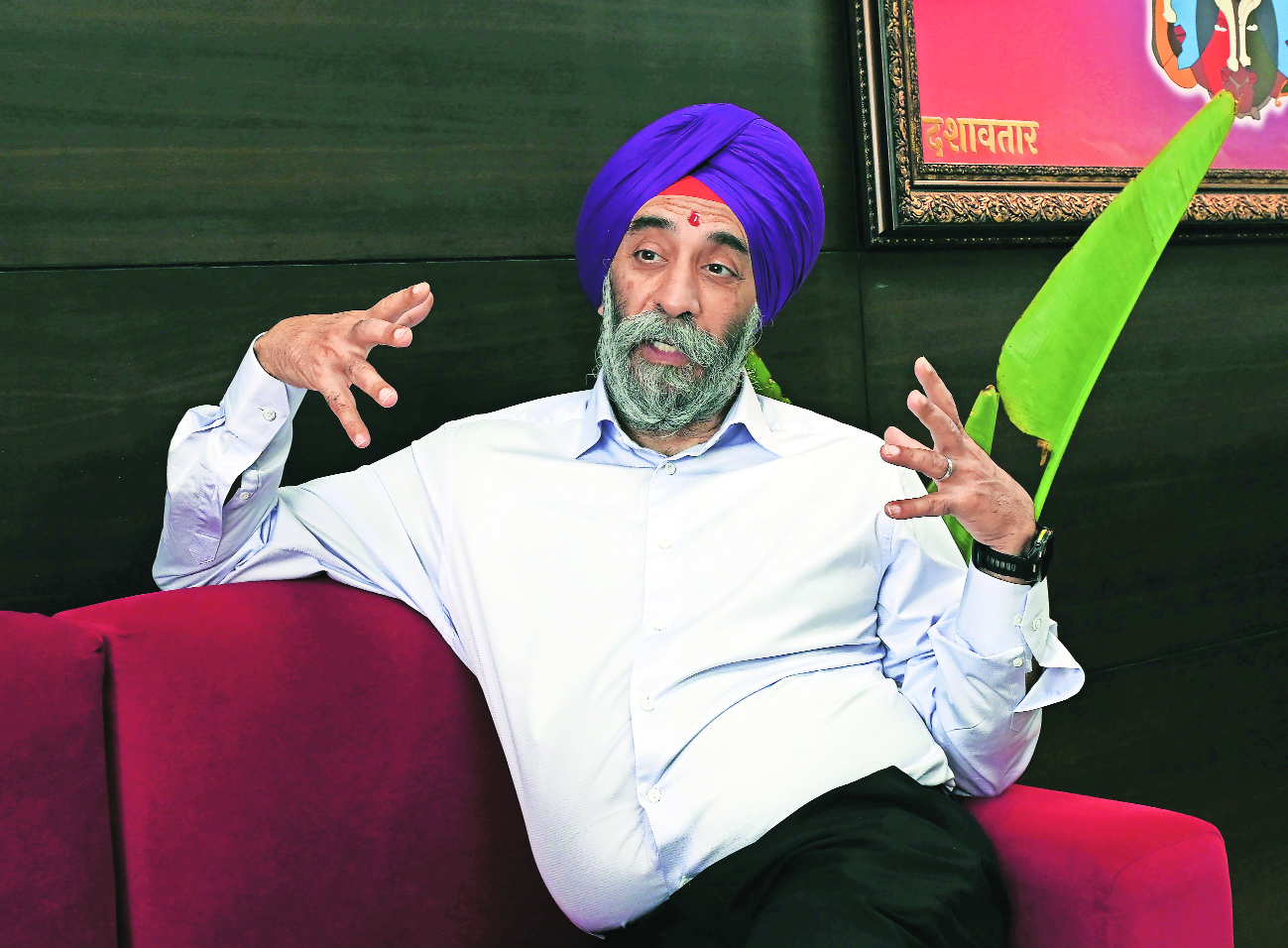
By Vijay Phanshikar :
FOR record, Dr. Mohanbir Sawhney is a high-caliber academic who has brought in a critical transformation in management education, a highly respected author of books on management, a globally-recognised corporate consultant on management and innovation in technological application, an amateur photographer with attributes of high professional standard. Deeply ensconced at the centre of all these attributes and achievements, however, there is a deep-thinking philosopher who has spent his lifetime defining the place and space and nature of human component that characterises all activities people undertake.
A graduate of IIT Delhi, an MBA from IIM Calcutta, a PhD from Wharton University, and now former Associate Dean, Digital Innovation at the McMormick Foundation Chair of Technology, Clinical Professor of Marketing and Director of the Centre for Research in Technology and Innovation at the Kellogg School of Management, Dr. Mohanbir Sawhney has travelled a great journey of personal achievement and contribution to larger cause of management science for the benefit of the universal human community. However, all along, his ideals and ideology evolved to a fine point. Even as he dealt with the business world where what counts most is hard numbers, Dr. Mohanbir Sawhney came to an inference that the human component needs to be freed from the cocoon of the limitations of thought. Very famously he once said, “To gain customer insights, we must understand that we are prisoners of what we know and what we believe”.
In other words, he says, we often bind ourselves in our limited cognition and emotion -- and of course incomplete knowledge. “Breaking orthodoxy is important for us”, he says in an interview with ‘The Hitavada’, during his short stay in Nagpur to fulfill his assignment as Advisor to the Board of ImmverseAI, Nagpur.
This has been Dr. Mohanbir Sawhney’s effort all along -- to help people in business or management (education or practice) to break free from the cocoon of orthodoxy so that they can think afresh all the time, inviting new ideas, welcoming innovation. Even as he advises top corporates the world over to emerge from the “prison of what we know and what we believe”, Dr. Sawhney expects them to evolve a culture of healthy doubts about whether things are right or not -- despite success. He then refers to the book by Andrew S. Grove of Intel titled “Only The Paranoid Survive”, insisting that one must develop a “healthy paranoia”.
Of course, this phrase can invite a deep discourse -- which Dr. Sawhney welcomes.
As he delves deeper into the thought, his eyes carry out an inner search of appropriate expression -- outwardly wandering around the room.
Then he turns to face you straight and insists, “What is needed to be developed most importantly is a culture of experimentation, agility, and intelligent failure -- in any organisation, whether business or academic”.
There, of course, is a catch. One wonders, how and why will profit -driven businesses entertain even the thought of the so-called “intelligent failure” when every rupee has its own criticality? Will that not mean allowing a massive waste of critical resource like money? Dr. Mohanbir Sawhney responds with a smile. He then proposes another concept -- Learning on Investment (LoI), instead of Return on Investment (RoI). He proposes: Engage yourself with properly calibrated experiments so that no resources are wasted, and that each experiment adds to the individual’s or organisation’s learning. In still other words, Dr. Sawhney advocates extreme mindfulness in business endeavours. One of his books (co-authored with Sanjay Khosla) is titled “Fewer Bigger Bolder: From Mindless Expansion to Focused Growth.” It makes a strong case for utilising every rupee/dollar mindfully and achieve higher growth in fewer resources with bigger and bolder moves.
As one draws Dr. Sawhney deeper into the discourse, one realises that the book does not try to oversimplify organisational conduct in pursuit of goals. Much to the contrary, the book advocates a mindful and sensible approach to growth -- far from the traditional thinking of bigger and better. His another book -- The Global Brain: Your Roadmap for Innovating Faster and Smarter in a Networked World (co-authored with Satish Nambisan) -- also favours an altogether different approach to the idea of innovation. In yet another book -- The Sentinent Enterprise: The Evolution of Business Decision Making (co-authored with Oliver Ratzesberger) -- also suggests importance of human component in a thinking, emoting business organisation. However, Dr. Mohanbir Sawhney has a question to raise here: “Which human component?”.
What does that mean -- one wonders. Easy -- the human component has many facets: the entrepreneur, the CEO, the Board, the investor-stake-holder, the larger society where the business exists, the work-force, Dr. Sawhney suggests. At this point, the discourse takes another twist -- arriving at a dicey point. How does one define this thing called ‘human component’? Probably, a lot of energy and time and thought need to go into looking for the right answer to this issue. It is at this point the philosopher Mohanbir Sawhney emerges most strongly -- urging the human conscience to make a decision about ‘which human component’.
The celebrated management ‘Guru’ relishes discussing the issue of human being vis-a-vis technology. He insists, technology -- in whatever form -- is created by man and is secondary to human interest.
That statement coming from him sounds so reassuring -- that good sense will always prevail and keep the overuse or abuse of technology making the human community subservient. That he is a strong proponent of human primacy also emerges from another point he makes most appropriately. -- of how human individuals or their organisations must respond to adversity. He says, “A good hunter does not waste the winter -- he spends that time sharpening his tools.” That assertion came when the world was fighting coronavirus. In those tough days, Dr. Mohanbir Sawhney said, in effect, that what made the greatest positive difference was the power of harnessing the adversity. This may sound rather commonplace as a thumb-rule. But there is a deeper idea in Dr. Sawhney’s assertion.
He seems to insist that entire science and art of management is nothing but systemisation of human thought so that it does not remain prisoner to limited knowledge and restricted belief. In the world of business where hard numbers drive every thought and action, Dr. Mohanbir Sawhney certainly carries along giving precious advice to corporates, but his words of wisdom are often tinged by his his deep-seated philosophical belief in primacy of human component -- making the businesses realise their opportunity to raise their own standards.