Core of film-making cannot be replicated by AI: Anuradha Singh
| Date :30-Mar-2026 |
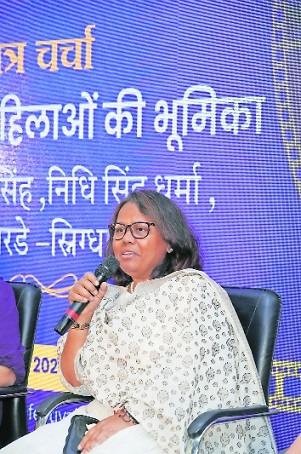
By Sayukta Lamsoge
and Reema Mewar :
Anuradha is a Hollywood film editor who has worked on Oscar winning projects like ‘Slumdog Millionaire’
“Perception, emotion, and script are the core of film-making, and right now, they cannot be replicated by AI.” said Anuradha Singh, a Patna-born film editor who has built a distinguished career in Hollywood. With over two decades of experience and international recognition, she has worked across major global platforms and projects, including the Oscar winning ‘Slumdog Millionaire’. Addressing the role of technology and artificial intelligence (AI) in film-making, Singh views it as inevitable but limited. “Technology cannot be avoided. You have to decide how to use it effectively, whether in storyboarding, animation, or VFX. I will use AI only if it does not harm my work.” She also added that emotional depth remains beyond its reach.
“AI cannot understand the depth of a character or the narrative. Film editing is about manipulating time and space, and creating emotion in the audience. Silence, in particular, is very important in cinema, and that instinct comes from human understanding.”
Journey to cinema
Her journey into cinema was not planned. “All my life, I wanted to be a neurosurgeon,” she recalled. “But after pursuing medicine, I attended a workshop on mass communication
where I discovered film editing. In a way, I was cutting there, and now I am cutting here, only better things,” she added humourously. “Honestly, sometimes destiny drives you. Nothing I planned really happened, so I learned to enjoy what life offers and do my best with it.”
Entering the film industry was not without its challenges. “Starting is always difficult. That is when you need the most perseverance and tenacity,” she said. “Every challenge made me a better technician and a better human being. When you are up against odds, that is when you create your best work.” She described the filmmaking process as intense and uncertain. “It is like carrying a child for nine months. You don’t know what the outcome will be. But when it ends, you emerge more refined, sometimes even discovering yourself in the process. There are times you will question yourself. But you must continue, because that is when you truly realise what you are capable of.”
Despite briefly exploring acting, Singh knew early on what her aim was.
“Once, I asked for the role of a blind person so I wouldn’t have to see myself,” she joked. “I was not good at acting. It is a difficult job. I enjoy being behind the camera, and after 21 years, I truly love what I do.”
Responsibility
as creators
On the question of responsibility in cinema, Singh said that filmmakers must be mindful of what they create. Even her own choice of projects is guided by the impact. “If I would like to watch a film as an audience, I take it up. Or if it carries a message within entertainment. That aside, emotion is very important in cinema. Emotion is what stays with you. That is what the audience takes home,” she added.
For young aspirants, especially women, Singh advised, “Dream, have the courage to pursue it, and the tenacity to keep that fire alive. If someone like me, from a small city in India, can reach Hollywood, so can others.”
International accolades
Singh’s work has also received international acclaim. During an event, renowned Hollywood actress Meryl Streep praised her contribution, saying that “Leslee (Udwin, a British filmmaker) must have given to you thouands of hours of footage, and you chose exactly what was needed to tell this story.”