CM Yadav stresses on simplicity, discipline, humility in pub, State Assembly Speaker emphasises on moral qualities to implement Constitution in true sense
| Date :31-Mar-2026 |
By Bhavana :
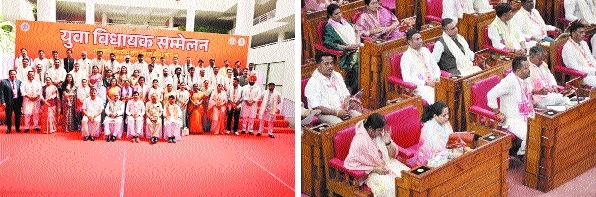
Inaugural day of three states’ Young Legislators Conference witnessed mentoring from veteran law makers and discussions on democratic participation and the vision for a developed India 2047 on Monday. The conference bringing together young MLAs from Madhya Pradesh, Rajasthan and Chhattisgarh. The event, ‘The Role of Young Legislators in Strengthening Democracy, Citizen Participation and Developed India 2047- Responsibilities and Challenges for Young Legislators’ is a part of the Commonwealth Parliamentary Association’s programme aiming to sharpen legislative skills and strengthen democratic traditions among the new MLAs.
Addressing the participants, senior leaders urged to maintain balance between public life and personal approach while dealing with critical issues. Madhya Pradesh Chief Minister Dr Mohan Yadav emphasised to opt for simplicity, modesty-void of arrogance and discipline in public life. Highlighting country’s progress and how now the world is looking at our country, “we should display courteous behaviour and work for enhancing public participation in democratic system. We should relentlessly work for the development of our respective constituencies”.
Along with the Madhya Pradesh CM, State Assembly Speaker Narendra Singh Tomar called for constructive role of Opposition and keeping public service at the helm of affairs.
The programme started with the national song ‘Vande Mataram’. Madhya Pradesh Parliamentary Affairs Minister Kailash Vijayvargiya, Leader of Opposition Umang Singhar, Rajasthan Assembly Speaker Vasudev Devnani and senior officials from all three states were present. MLAs under 45 are actively participating in
discussion on impactful role of young leaders to objectives of developed India and citizen in democracy.
In his key note address, Speaker Narendra Singh Tomar said, “It gives me immense pleasure and a sense of great pride to host the conference. Through the active participation of us all, this conference stands as a pivotal initiative aimed at reinforcing democratic traditions and
parliamentary values. Indeed, democracy is not merely a matter concerning a single individual, a specific community, a
particular province, or just one segment of society. Rather, democracy is empowered by the freedom, justice, equity, and equality of the nation’s citizens, along with their inherent dignity and spirit of fraternity. As citizens, the more vigilant and active we remain, the more inviolable and enduring our nation’s sovereignty and integrity shall remain.”
On January 26, our Republic completed 77 years. For any nation that has endured a long period of subjugation, this duration in the life of a republic may seem relatively brief; yet, it is a testament to the strength of our country’s culture, intellect, philosophy and civic consciousness that, even within this short span, India has emerged as the world’s most powerful democracy.
Hailing the contribution of Babasaheb Dr Bhimrao Ambedkar in democracy, he underlined the address delivered by Babasaheb to the Constituent Assembly on November 25, 1949. Babasaheb had observed that no matter how excellent a Constitution may be, it will ultimately prove to be flawed if the people implementing it are corrupt; conversely, no matter how flawed a Constitution may appear, it will ultimately prove to be sound if the people implementing it are virtuous.
Viewed in the light of this statement by Babasaheb, this is not merely a ceremonial event; rather, it is a platform for the convergence of democratic ideas, experiences, and perspectives, a space where elected representatives come together to envision a future that fosters a more participatory, inclusive, and accountable democracy.
It is a well-known fact that India is the world’s youngest democracy; yet, youth participation here remains a pertinent issue. Statistics reveal that in the First Lok Sabha, approximately 26 percent of the members were under the age of 30, while nearly half of the members were under 45. However, since then, this demographic representation has not seen a corresponding improvement.
Observing the young legislators gathered here evokes a sentiment that politics should be with the youth, not merely ‘for the youth.
While Governments can formulate schemes for the youth and the executive branch can implement them, an elected representative, specifically a young legislator, plays an active role on both fronts: from the conceptualisation of policies to their actual implementation; indeed, in a sense, they also assume the role of an overseer. As young legislators, while on one hand they ensure youth participation in policy matters, on the other, they can also play an active role in the development of better citizens.
The vision of our nation’s illustrious Prime Minister, Narendra Modi, has also centered on enhancing the participation of the youth as citizens within our democracy. Prime Minister Modi has stated that achieving ambitious goals is not solely the responsibility of the government machinery; rather, it necessitates the collective effort of every single citizen.