Megalithic heritage at Mahurjhari found damaged
| Date :06-Mar-2026 |
By Kunal Badge :
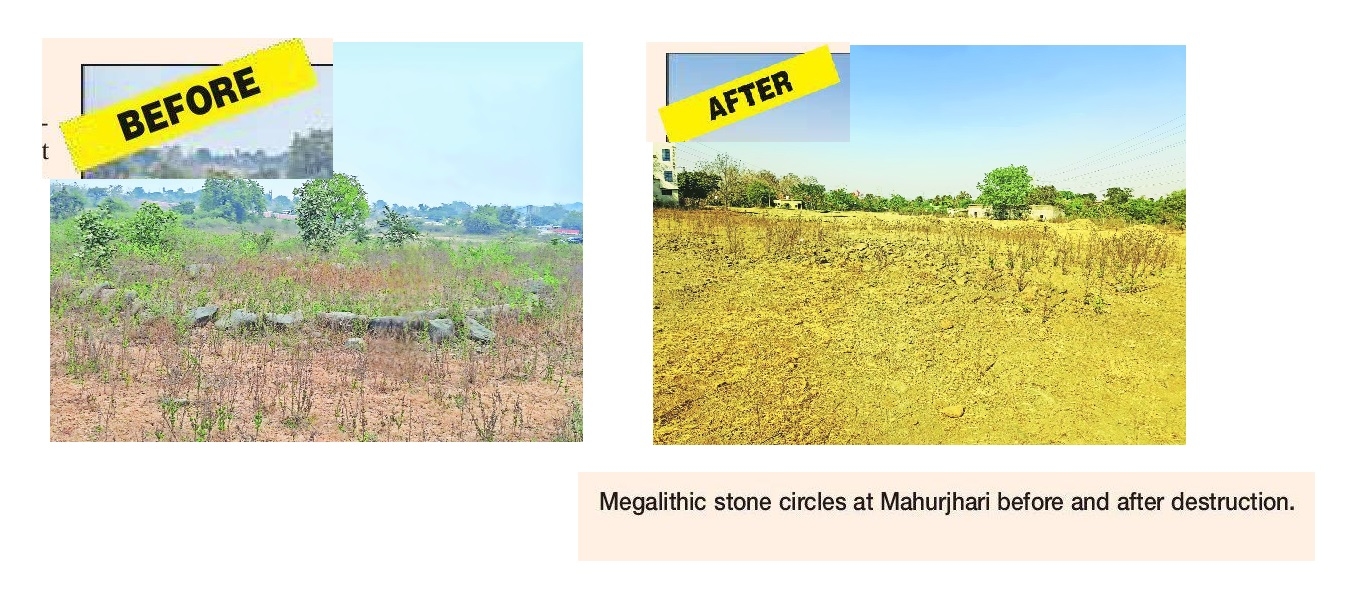
Even as governments and institutions frequently speak about preserving India’s cultural heritage, several historically significant sites continue to disappear due to administrative neglect. A recent incident at Mahurjhari, located on the outskirts of Nagpur, has once again highlighted this concern. Archaeologically important megalithic stone circles at the site were recently levelled using earthmovers, allegedly during development-related work, leading to the loss of valuable heritage.
The damage was noticed by a group of archaeology enthusiasts who had travelled from Madhya Pradesh to visit the site.
They were shocked to find that the ancient stone circles had been disturbed. The site, along with the nearby Junapani complex, once had one of the largest concentrations of megalithic stone circles in the country. While the circles at Junapani are protected, the Mahurjhari structures have remained unprotected, making them vulnerable to encroachment and developmental activities. In the recent incident, the last two remaining stone circles
at the site were reportedly destroyed.
Archaeological importance of Mahurjhari
Prabhash Shahu, HoD Ancient Indian History, Culture and Archaeology at Rashtrasant Tukadoji Maharaj Nagpur University (RTMNU), described the destruction as a major loss for the archaeological environment of the region. According to him, the site at Mahurjhari was first discovered in 1933 and has since been excavated by institutions, including the Archaeological Survey of India (ASI), RTMNU, and Deccan College, Pune.
Excavations carried out over several decades revealed important evidence of early Iron Age culture in the Vidarbha region. Although little evidence of habitation has been found, archaeologists uncovered burial sites containing human skeletal remains along with iron artefacts such as daggers, axes, rings, and bracelets.
Evidence of trade and cultural links
Excavations also revealed a large number of beads made from semi-precious stones. British archaeologist Hunter had earlier suggested that Mahurjhari might have been a bead-making centre, from where such ornaments were possibly exported to Central Asia. This indicates the existence of early trade networks and technological skills among the inhabitants of the region.
The megalithic sites of Vidarbha are known for their archaeological richness, but Mahurjhari and Junapani stand out because of the scale of their stone circles and the unusual discoveries associated with them. Archaeologists have also found facial ornaments used for horses, indicating the importance of the animal in the lives of these communities.
Unique discoveries
Archival records also describe an unusual burial discovered during excavations. The remains belonged to an individual whose lower legs were missing, while a dagger with an iron blade and copper hilt was placed on the chest. Another distinctive feature of Mahurjhari was the presence of cup-marks carved into some stones of the circles, which scholars believe, may have had astronomical significance.
Lack of protection and repeated loss
Despite its importance, Mahurjhari is not a protected monument. Senior officials from the Archaeological Survey of India have stated that the site does not fall under their jurisdiction. The lack of legal protection has raised serious concerns among historians and archaeologists about the future of such heritage sites. The destruction of megalithic sites in the region is not unprecedented. Similar sites at Takalghat-Khapa and Raypur-Hingna have earlier been damaged or destroyed in the name of development.
Need for urgent conservation measures
Archaeologists point out that there are practical solutions to protect such heritage. In places such as Nagarjunakonda, archaeological remains were carefully relocated from their original location to prevent damage while still allowing visitors to witness the structures. A similar approach, experts say, could have been adopted in the case of Mahurjhari.
With the destruction of its remaining stone circles, Mahurjhari has lost another important monument of the Vidarbha megalithic culture. Unless authorities take proactive steps to identify and safeguard such sites, scholars fear that this ancient legacy may soon survive only in historical records rather than in the landscape where it once flourished.