Backstage Playmakers introduces immersive theatre at home with Elkunchwar’s ‘Sonata’
| Date :07-Mar-2026 |
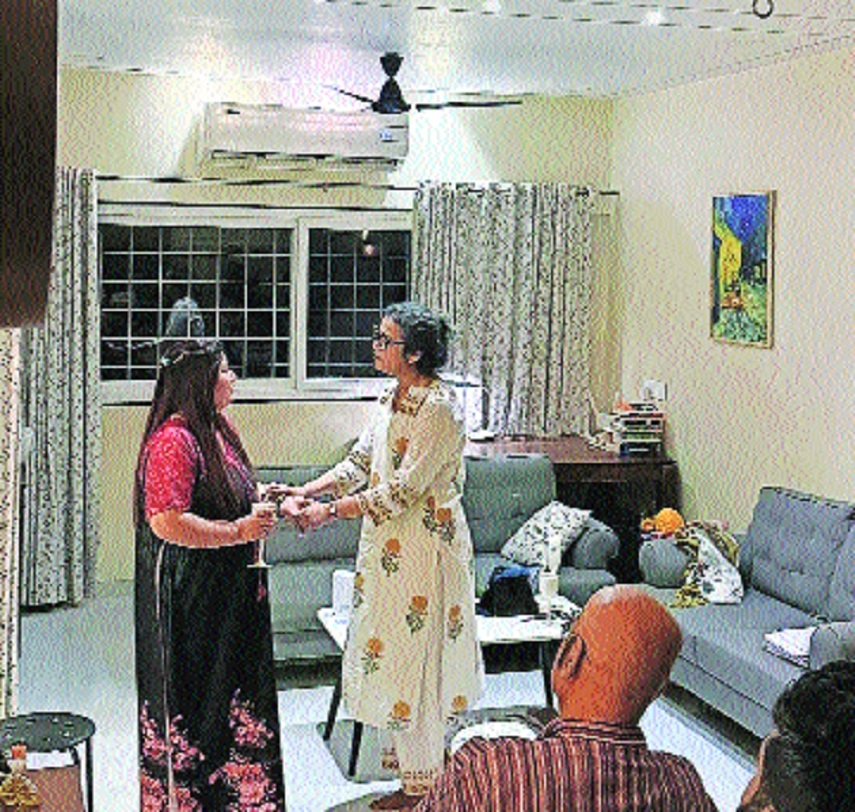
Sonal Trivedi-Malkan in her role as Purbi (left) and Bianca
Nazreth-Arya in her role as Aruna, during the staging of ‘Sonata’
on Friday evening.
Staff Reporter :
Sonal Trivedi-Malkan as ‘Purbi’, Radhika Joshi as ‘Subhadra’ and Bianca Nazreth-Arya as ‘Aruna’ were the lead
An ordinary living room of a residence in Shankar Nagar became a space for the theatrical performance on Friday as Backstage Playmakers staged ‘Sonata’, a play by Mahesh Elkunchwar, in an intimate ‘theatre at home’ format. Instead of a traditional auditorium, the production was performed inside a private residence, with a limited audience seated only a few feet away from the actors.
Written in 2000, ‘Sonata’ examines the emotional lives and loneliness of urban women.
The story follows three single, working women living in a metropolitan city who appear confident, independent and professionally accomplished, yet carry private anxieties and unresolved tensions. In this production, the characters — Purbi, Aruna and Subhadra — from different professional and social backgrounds whose lives intersect through friendship and solitude. They represent a generation of urban women who live independently and navigate their personal and professional lives on their own terms. Their conversations move between casual banter, moments of vulnerability and uncomfortable revelations, gradually exposing the emotional complexities beneath. While the three women share companionship and freedom, their interactions also reveal unspoken conflicts, insecurities and differences in perspective.
The living-room setting played a crucial role in shaping the audience’s experience. With only a handful of viewers seated within the same space as the performers, there was little distance between actor and audience. The intimacy of the environment heightened the sense of realism, allowing viewers to observe subtle expressions, pauses and shifts in tone that might otherwise be lost on a conventional stage.
According to the production team, the format was intended to place the audience directly inside the emotional landscape of the play.
One viewer described the experience as feeling ‘almost like being invisible and watching someone’s life unfold from within the same room’. By removing the physical separation of a stage, the performance allowed viewers to feel the tension, discomfort and vulnerability experienced by the characters as their conversations unfold.
More than two decades after it was first written, Mahesh Elkunchwar’s exploration of friendship, independence and emotional isolation among urban women continues to resonate with audiences.