188-yr-old banyan shows rapid leaf devpt120 days after transplant from Pachpaoli
| Date :01-Apr-2026 |
By Simran Shrivastava :
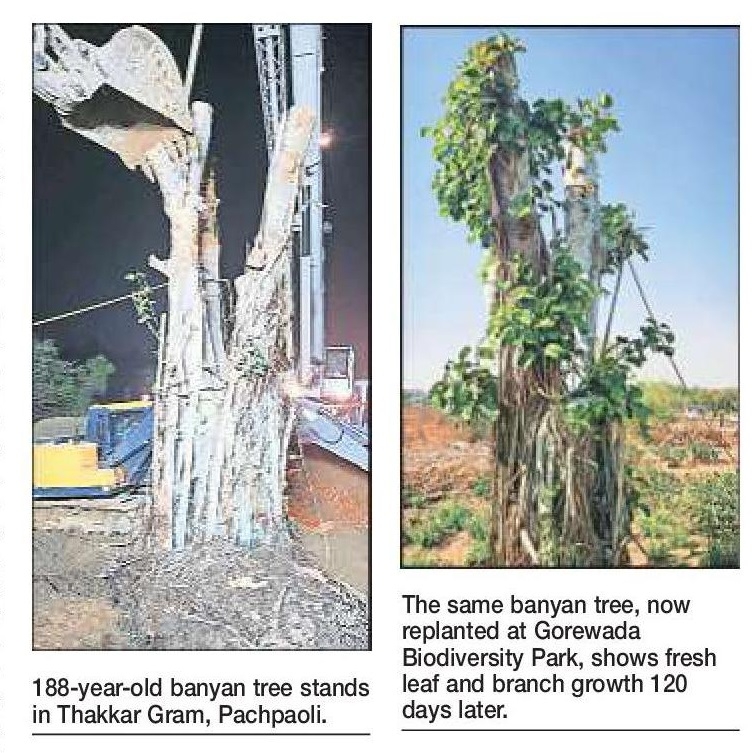
A 188-YEAR-OLD banyan tree
(Ficus benghalensis) transplanted from Thakkar Gram,
Pachpaoli, to Gorewada
Biodiversity Park in November
2025 is showing rapid leaf and
branch development 120 days
after the operation despite temperatures of 40 degrees Celsius,
according to court-appointed
botanistDilipChinchmalatpure,
Co-ordinator, Nagpur
Beautification Committee, who
oversaw the transplantation.The
tree, 42 feet tall and 34 feet in
girth, was moved nine kilometres across the city after a Public
Interest Litigation (PIL) in
Bombay High Court stopped it
from being felled to make way
for a proposed three-storey elibrary.
Chinchmalatpure, who
has been monitoring the tree
since November, must submit a
status report to the court every
seven days and will continue
doing so for seven years.
Roots wrapped
in gunny bags,
nets, burlap
BANYAN treeshave root systems
that extend to nearly twice the
tree’sheight, and theNagpur sun
at 40 degrees Celsius can quickly destroy exposed roots. Three
JCBs and hydraulic lifters were
used to loosen and extract the
tree from Pachpaoli’s narrow
lanes.
Workers carved trenches around the tree and carefully
shielded the roots before
machinerymovedin.Once freed,
the roots were wrapped tightly
in gunny bags, nets and burlap
with their original soil intact to
forma securedrootball.Thetree
was then lifted onto a trailer and
transported toGorewada,where
a prepared pit was ready. “Zero
root damage was the primary
rule,” Chinchmalatpure
explained. The entire process
from uprooting tore planting was
completed within 24 hours.
Transplantation
results in 100 new
branches, to be 10
AFTER replanting, root hormones were applied to help thetreeanchorinnewsoiland fungicides were used to seal pruningwounds. The soil mix was specially prepared using black soil,
cow dung, neem cake as an antifungal agent and micronutrients suited for the banyan species.
The transplantation has resulted in approximately 100 newbranches. Chinchmalatpureplans to reduce these to 10through a process called disbranching, a selective pruningmethod that ensures structural
strength and balanced growth.
“Disbudding and disbranchingensure trees grow tall and balanced,” he told. The BombayHigh Court had mandated the transplantation with specific conditions. It was noted during proceedings that the ideal season for transplanting banyantrees is monsoon or winter, but
the work was carried out within the court-mandated timeline.
Chinchmalat pure was appointed as the court’s expert for theoperation.Its next review reportis due at the High Court thisweek.