Decisive blow to Maoists in Bastar, 35 cadres surrender across 5 districts; arms, cash recovered
| Date :01-Apr-2026 |
Our Correspondent
:
IN A significant push towards the
goal of a Naxal-free Bastar, security forces have registered fresh
successes across Dantewada,
Sukma, Kanker, Narayanpur and
Bijapur districts, with 35 Maoist
cadres surrendering and substantial recoveries of arms,
ammunition, explosives, and
cash from insurgent hideouts.
The coordinated developments highlight a steady
weakening of Maoist influence
in the Bastar region, driven by
sustained operations, intelligence-based actions, and rehabilitation initiatives.
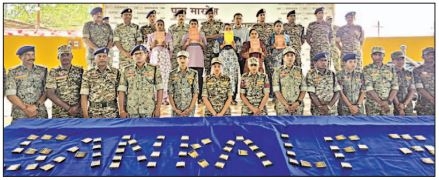
In Dantewada district, five
Maoist cadres, including four
women, affiliated with the
Dandakaranya Special Zonal
Committee (DKSZC),
surrendered and joined the mainstream. The cadres carried a combined bounty of Rs 9 lakh. They were identified
as ACM Some Kadti, who carried a reward of Rs 5 lakh,
along with party members Lakhma Oyam,
Sarita Podiyam, Jogi Kalmu, and Moti Oyam, each carrying rewards of Rs 1 lakh. They belonged to the Bhairamgarh
and Gangloor area committees of the West Bastar Division.
Acting on intelligence provided by the surrendered cadres,
security forces conducted operations at multiple locations
and recovered a cache of 40 weapons, including SLR rifles,
INSAS rifles, one carbine, one .303 rifle, and BGL launchers, among others. Officials described the recovery as a major
blow to Maoist military capabilities.
The surrendered cadres cited the declining relevance of
Maoist ideology and increasing pressure from security
forces as key reasons for laying down arms.
In Sukma district, two Maoist cadres, each carrying a
reward of Rs 8 lakh, surrendered before senior police officials at the Reserve Police Centre.
The cadres—Janila alias
Madkam Hindme and Madvi Kosi, members of Company
No. 08 of the KKBM Division—expressed their willingness
to renounce violence and return to the mainstream.
Subsequent intelligence-based operations led to the
recovery of a Maoist dump, including Rs 10 lakh in cash
and automatic weapons such as one INSAS LMG rifle, two
AK-47 rifles, and three .303 rifles, along with ammunition.
Officials said sustained operations have forced Maoists to
abandon weapons and resources in forested areas, indicating weakening logistical capabilities.
In Kanker district, two Maoist cadres surrendered before
police. They were identified as Shankar, a Party Platoon
Company Member, and Hidma Dodi, a Party Member, both
carrying rewards of Rs 8 lakh each. They surrendered along
with an AK-47 rifle. Police said intelligence gathered from
them will be used to reach out to other active cadres and
encourage further surrenders.
In Narayanpur district, Bijlu Mandavi (26), a Maoist cadre
carrying a reward of Rs 1 lakh, surrendered before
Superintendent of Police Robinson Gudiya under the “Maad
Bachao Abhiyan.” A resident of Tushwal village under the
Barsoor police station area in Bijapur district, he was associated with the North-West Joint Sub-Zonal Bureau TD
team and chose to return to the mainstream.
In Bijapur district, a total of 25 Naxalites surrendered and
joined the mainstream, handing over 93 weapons, including four AK-47 rifles and nine SLRs. Authorities also recovered a major dump valued at Rs 14.06 crore, which included Rs 2.90 crore in cash and 7.2 kg of gold worth Rs 11.16
crore. Under the rehabilitation initiative, each surrendered
cadre was provided Rs 50,000 as immediate assistance. Joint
operations by district police and security forces in
Narayanpur also led to the recovery of weapons, ammunition, explosives, and daily-use items from Maoist hideouts. Across all districts, officials attributed the rise in surrenders to sustained security pressure, effective intelligence gathering, and improved rehabilitation policies.
Surrendered cadres cited disillusionment with Maoist ideology and hardships within the organisation as key reasons
for their decision.
Under the State’s rehabilitation policy, surrendered cadres
receive Rs 50,000 as immediate assistance, along with additional benefits aimed at ensuring their reintegration into
society. Senior officials said initiatives such as “Puna Margem
– Rehabilitation to Renewal” are playing a crucial role in
encouraging Maoists to abandon violence and adopt a normal life. They also appealed to remaining cadres to take
advantage of the policy and surrender.
Officials emphasised that the combined approach of
strong security action and rehabilitation support is steadily weakening Maoist networks, reducing their operational
strength, and paving the way for lasting peace and development in the Bastar region.