Sharma claims end of armed Naxal cadre
| Date :01-Apr-2026 |
Staff Reporter
:
CHHATTISGARH Home
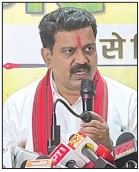
Minister Vijay Sharma on
Tuesday described March 31
as a ‘historic day,’ asserting that
the armed cadre of Naxalism has
effectively ended in State.
Addressing a press conference
at the Raipur Press Club,
he said the decades-old insurgency issue has been resolved
within a span of two years
through a coordinated and multi-dimensional approach.
Sharma said the turning point
came after the formation of the
BJP government in December
2023, when a high-level meeting
involving Security Forces and
police leadership from neighboring states was convened. The
review revealed that nearly 75
percent of Naxal activity and
around 90 percent of its armed
cadre were concentrated in
Chhattisgarh, particularly in
Bastar, making the state the center of the insurgency.
He credited Amit Shah for setting a definitive deadline to eliminate armed Naxalism by March
31, 2026, calling it a bold and
unprecedented decision.
According to Sharma, a detailed
roadmap was later presented in
Delhi, focusing on coordinated
operations, intelligence strengthening, and community engagement.
Sharma said intelligence gathering was significantly enhanced
using technology, enabling security forces to conduct precise
operations with minimal risk. He
claimed that these efforts resulted in zero casualties among security personnel during several key
operations. He also dismissed
earlier allegations by opposition
leaders regarding fake encounters, stating that even Naxal leadership had acknowledged casualty figures consistent with official records.
Highlighting the role of local communities, Sharma said
people of Bastar played a crucial part by withdrawing support for Naxal groups and encouraging youth to return to
mainstream life. Panchayati Raj representatives, community leaders, journalists, and civil society groups were actively involved in persuading cadres to opt for rehabilitation.
He emphasised that the government consciously moved
away from the term “surrender,” promoting rehabilitation
with dignity. Feedback mechanisms, including outreach
initiatives and communication in local languages such as
Gondi, were introduced to build trust. Rehabilitation centers were established across districts, offering training,
housing, and reintegration support.
According to Sharma, nearly 3,000 Naxals have been
rehabilitated over the past two years, while around 2,000
were arrested and 536 neutralised.
He claimed that about 99 percent of the armed cadre has
been eliminated, with only a small number of individuals
remaining scattered in parts of north and south Kanker.
These individuals, he said, are no longer organised and are
eligible for rehabilitation.
He added that some members linked to the DKSZC are
currently operating outside the state, particularly in
Telangana, and were not included in the state’s figures.
Within
Chhattisgarh, he asserted, there are no active structured
armed units remaining. Sharma also spoke about efforts
to counter Naxal influence through cultural and social initiatives such as the Bastar Olympics and Bastar Pandum,
which saw participation from lakhs of youth. Former insurgents from other states who had successfully reintegrated
were brought in to share their experiences, creating a ripple effect among local cadres.
He further highlighted the voices of victims of Naxal violence, including those injured in IED blasts, who have
begun asserting their rights and engaging with democratic institutions. Some of these victims recently reached out
to national platforms, raising awareness about their experiences. Calling it a victory of democracy, Sharma said the
ideology of capturing power through armed struggle has
been rejected, and people are now actively participating
in governance and development. He concluded that Bastar
is witnessing a new phase where residents can move freely
and demand development without fear, marking a decisive shift from decades of conflict.