Israel’s Beirut strike kills over 300
| Date :10-Apr-2026 |
BEIRUT :
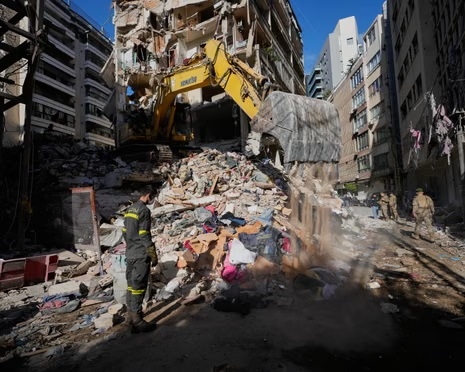
LEBANON’S Health Ministry said Thursday that at least 300 people were killed in widespread Israeli strikes in Central Beirut and other areas of Lebanon on Wednesday.
It said more than 1,000 were wounded. The death toll Wednesday was the highest for a single day in Lebanon during more than five weeks of renewed war between Israel and the Lebanese militant group Hezbollah.
The Israeli military said it targeted Hezbollah sites.
However, several of the buildings that were struck without warning during the afternoon rush hour were in densely-packed commercial and residential areas, leading to widespread civilian casualties. Israel said it killed an aide to Hezbollah leader Naim Kassem in its intense airstrikes that hit Lebanon’s capital, Beirut. It identified the man killed as Ali Yusuf Harshi, a secretary and nephew to Kassem.
A tentative ceasefire in the Iran war staggered under the weight of Israel’s bombardment of Beirut, Tehran’s continued chokehold on the Strait of Hormuz, and uncertainty over whether talks expected on April 10 can find common ground. Iran and the US - which both declared victory after ceasefire announcement - appeared to apply pressure. Semiofficial news agencies in Iran suggested forces have mined the Strait of Hormuz, a crucial waterway for oil whose closure has proved Tehran’s greatest strategic advantage. Trump, meanwhile, warned that US forces would hit Iran harder than before if it did not fulfill the agreement.
And there was disagreement over whether the ceasefire deal included a pause in fighting between Israel and Hezbollah.
Questions also remain over what will happen to Iran’s stockpile of enriched uranium at the heart of tensions, how and when normal traffic will resume through the strait, and what happens to Iran’s ability to launch future missile attacks and support armed proxies in the region.Semiofficial news agencies in Iran published a chart Thursday suggesting the country’s paramilitary Revolutionary Guard put sea mines into the Strait of Hormuz during the war - a message that may be intended to pressure the United States.
The chart, released by the ISNA news agency and Tasnim, showed a large circle marked “danger zone” in Farsi over the route ships take through the strait, through which 20 per cent of all traded oil and natural gas once passed.
Only a trickle of ships have transited since the war began after several were attacked and Iran threatened to hit any that it deemed connected to the US or Israel. Ships appeared to continue to avoid the strait even after the ceasefire.
The chart suggested that ships travel through waters closer to Iran’s mainland near Larak Island, a route that some ships were observed taking during the war. It was dated from February 28 until April 9, and it was unclear if the Guard had cleared any mines since then.
Iran’s Deputy Foreign Minister, Saeed Khatibzadeh, told the BBC that his country will allow ships to pass through the strait in accordance with “international norms and international law” once the United States ends its “aggression” in the Middle East and Israel stops attacking Lebanon.
The head of the UAE’ major oil company, Sultan al-Jaber, said some 230 ships loaded with oil were waiting to get through the strait and must be allowed “to navigate this corridor without condition.”
The strait’s de facto closure has caused oil prices to skyrocket - affecting the cost of gasoline, food and other basics far beyond the Middle East. Trump said Wednesday that the US would work with Iran to remove the uranium, buried in last year’s US and Israeli strikes, though Iran did not confirm that. In one version of the ceasefire deal that Iran published, it said it would be allowed to continue enrichment.
The chief of Iran’s nuclear agency, Mohammad Eslami, said Thursday that protecting Tehran’s right to enrich uranium is “necessary” for any ceasefire talks.
Ship-tracking data from Kpler showed only four vessels with their Automatic Identification System trackers on passed through the Strait of Hormuz on Wednesday, the first day of the ceasefire.
However, that does not include so-called “dark fleet” vessels, which travel with their AIS trackers turned off. Many of those “dark fleet” ships carry sanctioned Iranian crude oil out to the open market.