Haaf gasping for breath Flow may cease within a week; Drinking water crisis looms in over 200 villages
| Date :11-Apr-2026 |
Our Correspondent :
PANDARIA :
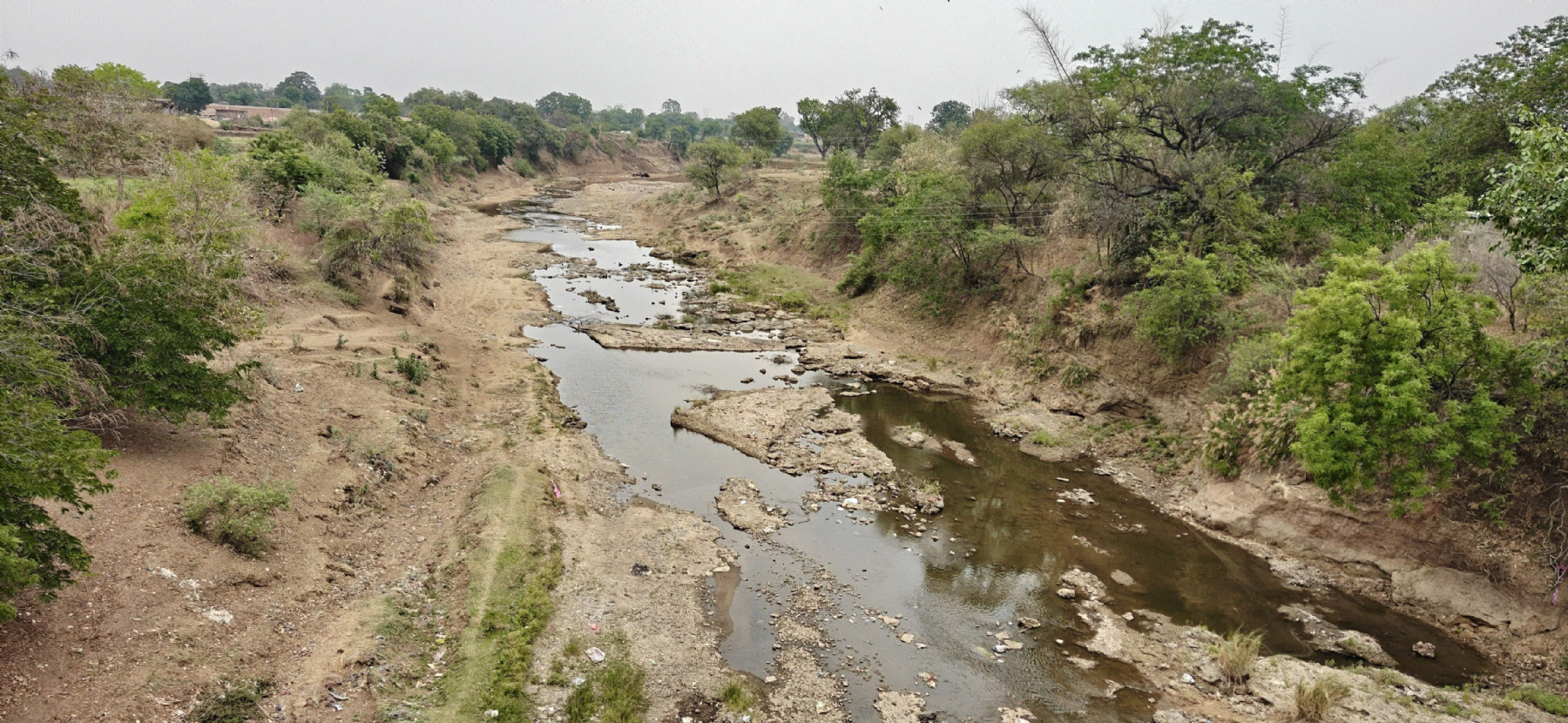
HAAF River, a vital lifeline for Pandaria town and adjoining rural areas, is on the verge of drying up, with its flow likely to cease completely within a week.
The sharp decline in water level has raised serious concerns of an impending drinking water and domestic-use crisis across more than 200 villages dependent on the river.
Stretches of the river beyond Bishesara village have already dried up, while water now remains only at isolated locations where stop dams exist. With the flow weakening rapidly, the situation in riverbank villages is expected to worsen further in the coming days as temperatures continue to rise.
It needs to be mentioned here that Haaf River originates from the Maikal mountain range between Pandripani in the forest region of Pandaria block and Daldali in Bodla block. It flows through Bemetara district before merging into the Shivnath River near Nandghat. With a length of approximately 45 kilometres, it is the longest and most significant river in the district. Despite its importance, the river is witnessing rapid seasonal depletion due to lack of effective conservation.
The drying of the river has already led to a decline in groundwater levels in nearby villages such as Navagaon, Dhobghatti, Domsara, Piparkhunti, Kharhatta, Dullapur and Akhara. Several hand pumps in these areas have stopped functioning, while others are yielding minimal water, making it increasingly difficult for residents to meet their daily needs. Notably, the river did not dry up during 2020 and 2021. However, in recent years, it has been consistently drying up during the months of March and April. Experts and locals attribute this trend to excessive human interference, unregulated extraction of water, and environmental degradation, including indiscriminate sand mining. The Haaf River sustains the livelihoods of people in more than 200 villages. Residents depend on it for agriculture, vegetable cultivation, brick-making and other economic activities. Its depletion poses a dual threat—affecting both drinking water availability and the rural economy.
It is worth mentioning here that around 10 to 12 years ago, the Haaf River was perennial, with water flowing throughout the year. However, continuous overexploitation and increasing human intervention have transformed it into a seasonal river that now dries up during peak summer. Experts and local residents have stressed the urgent need for conservation efforts. Rising pollution levels, indiscriminate water usage and illegal sand mining have disrupted the river’s natural flow. Despite the seriousness of the issue, no concrete measures have been undertaken so far. Coordinated efforts between the administration and the public are essential to restore and preserve the river.
Water availability remains relatively stable in areas with existing stop dams, helping maintain groundwater levels in nearby villages. However, a nearly 10-km stretch between Kuba Khurd and Baniya Kuba — covering Bishesara, Rauha, Manjholi, Devpura, Dhobghatti, Navagaon Hathha, Domsara, Piparkhunti and Kharhatta — lacks such structures, resulting in acute water scarcity. Residents have suggested that construction of stop dams near Dhobghatti and Domsara could significantly ease the situation in these areas. “Stop dams are being constructed as per the needs and demands of villages. Proposals for required locations will be forwarded,” said Kaushal Kishore Sharma, SDO, Irrigation Department, Pandaria. With summer intensifying, residents now look towards immediate administrative intervention to prevent the crisis from escalating further.