Advanced Radar System at airport set for commissioning by Sept
| Date :12-Apr-2026 |
Staff Reporter :
In a significant leap toward aligning air traffic safety and surveillance with global standards, Raja Bhoj Airport is nearing the completion of its Monopulse Secondary Surveillance Radar (MSSR) upgrade. This state-of-the-art system is engineered to provide precise geographic tracking of aircraft and ensure flawless identification even during peak traffic congestion or adverse weather conditions.
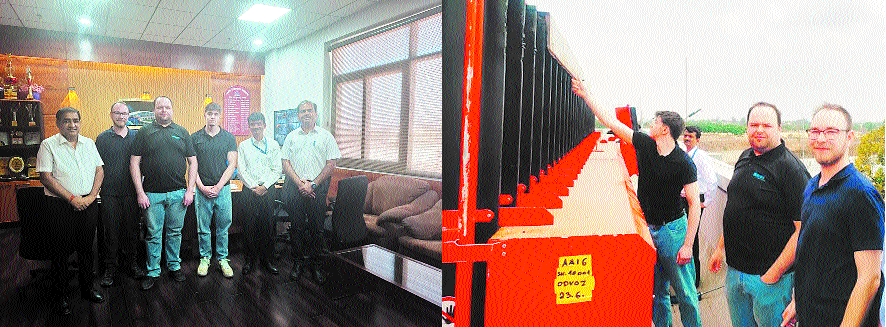
A specialised team of senior engineers from ELDIS Pardubice, a renowned Czech Republic-based firm, has arrived in Bhopal to spearhead the project. The experts held a high-level review meeting with the Airport Director and the technical team to finalise the installation roadmap and conduct micro-inspections of the equipment. Beyond hardware set-up, the team will calibrate the system to suit local geographic topography.
Strategic hub for national air traffic: The new MSSR in Bhopal will transcend local flight management, functioning as a strategic data hub for Indian airspace. The real-time radar feed generated here will be shared directly with India’s busiest Air Traffic Control (ATC) centres, including Nagpur, Delhi, Ahmedabad, Mumbai and Varanasi.
This integration will prove pivotal for managing ‘en-route’ flights; as aircraft transit through Central Indian skies at high altitudes, Bhopal’s radar will relay precise movement data to these major centres.
Ending the era of conventional monitoring: The aviation sector is moving away from the ‘conventional method’ where ATCs relied heavily on radio frequency communication and pilots’ estimated co-ordinates due to radar gaps. With the integration of automation and Artificial Intelligence, the ATC screens will now autonomously reflect the speed, altitude, direction, and precise estimated time of arrival (ETA) for every aircraft.
A milestone in preventing mid-air collisions:
The hallmark of this system is its ‘Monopulse’ technology. Unlike traditional systems, it decodes an aircraft’s identity and location using a single signal pulse. This level of precision is critical when multiple aircraft operate at the same altitude or within the same corridor, making it significantly easier for ATCs to maintain ‘separation standards.’ Furthermore, the radar is designed to remain unhindered by heavy rain, dense fog, or thunderstorms, ensuring uninterrupted surveillance.
Commissioning by September: Civil works, including the construction and painting of the radar tower building, have already been completed. Current efforts are focused on the complex process of software integration and component assembly under expert supervision.