In conversation with craft: Pankaj Kapur reflects on a lifetime in acting
| Date :12-Apr-2026 |
Staff Reporter :
Reflective pauses and studied gaze silently blossomed into an invisible but a telling aura. A creative vibe filled the place and Pankaj Kapur took over minds with his fantastic journey in the world of celluloid. As the veteran peeled off layers of the dream world, the audience started feeling the depth of cinema, and acting, and drama, and life.
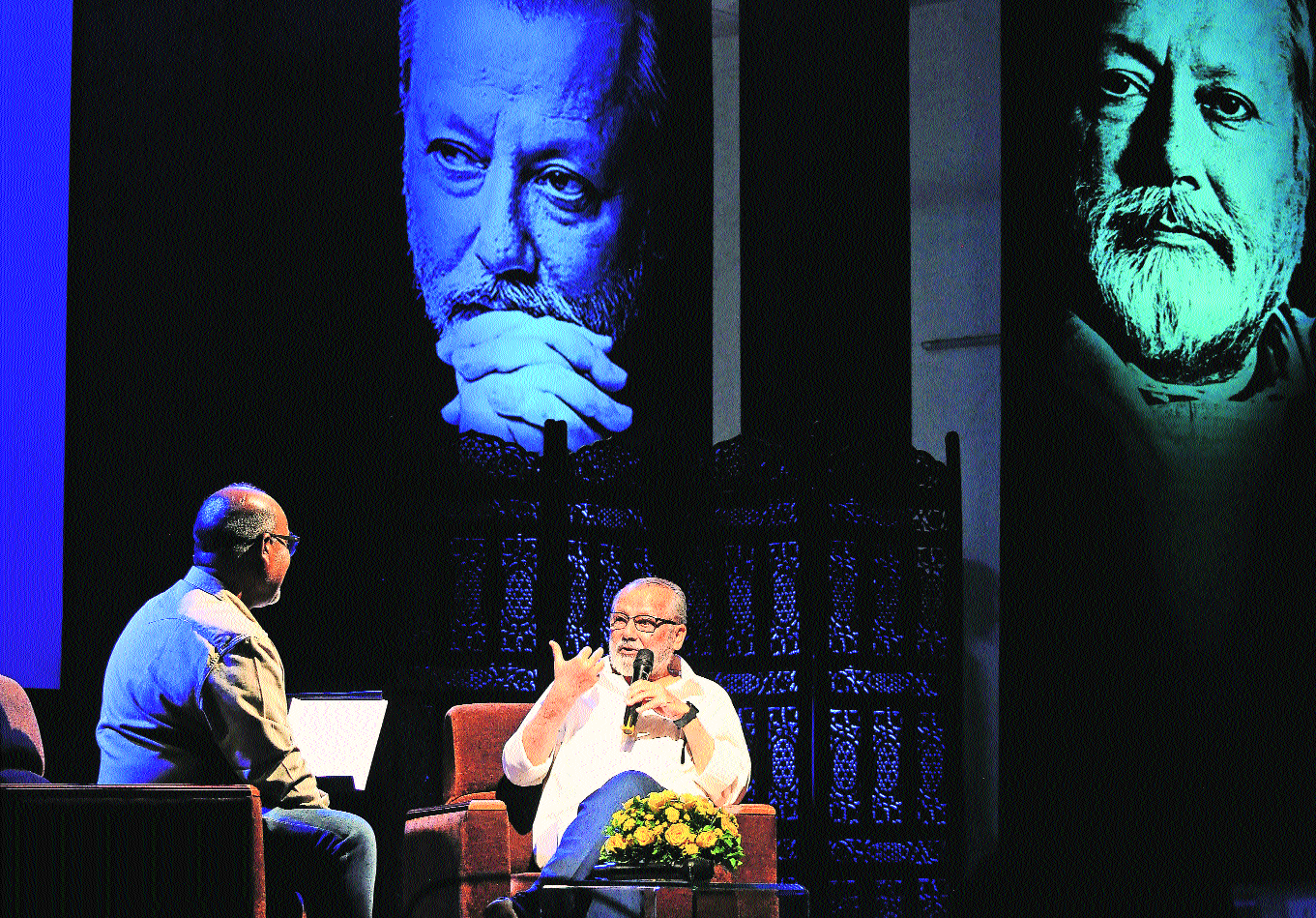
The session, jointly organised by the Pune International Film Festival Nagpur Edition and Meraki Theatres, churned out a steady and reflective account of how an actor is shaped over time -- through discipline, doubt, and an ongoing engagement with the world beyond the screen.
In conversation with Ajey Gampawar, Kapur, one of the most respected actor-directors in Hindi cinema, began at the beginning -- his decision to
pursue acting.
He recalled that his father met his choice
with encouragement, but also with a question that stayed
with him: “Are you interested in the film industry because of
the glamour, or your genuine love for acting?” It was, in many ways, the first test of intent,
one that would underpin a career defined more by substance than spectacle.
That emphasis on grounding found a clear shape during his
time at the National School of Drama (NDS), under the mentorship of Ebrahim Alkazi. Kapur recalled picking up ‘An Actor Prepares’ by Konstantin Stanislavski, secretly with the intention of impressing Alkazi, only to be advised by him to set it aside. “Don’t read it yet,” he was told, an instruction that seemed counterintuitive in a space that values theory. Decades later, Kapur admitted he never returned to the book. Instead, he credited that moment for allowing him to discover his own process, unburdened by prescribed methods. “I remain grateful to Alkazi sahab for letting me grow into my career myself,” he said.
If anything, Kapur’s reflections pointed to a broader, more immersive idea of education. Alkazi, he recalled, insisted that an actor cannot do justice to a role without understanding people, languages, and cultures, and that such understanding comes from reading. For Kapur, this translated into a lifelong habit that deepened his engagement with characters, especially those rooted in unfamiliar contexts.
Kapur was equally clear about the value of formal training. Comparing it to a controlled lake, he explained how structure sustains longevity. “If a lake is controlled, it can generate electricity, be used for irrigation, and serve many purposes while remaining alive,” he said. “If not, it may overflow or lose its usefulness.”
The analogy extended naturally to acting --training, he suggested, does not restrict creativity but channels it, allowing an artist to endure and evolve rather than fade after brief success.
Across his work, that attention to control often reveals itself in detail. Speaking about Maqbool, an adaptation of Macbeth, he pointed to how a seemingly small moment, a line like “Gilauri khaaya karo Ghulfaam,” could alter the emotional texture of an entire scene. It was a reminder that performances are often built not on grand gestures, but on carefully observed nuances.
At the same time, Kapur did not shy away from acknowledging the unpredictability of cinema. Mausam, a project he worked on for over four years while denying any other acting jobs that came his way, did not meet expectations at the box office. Yet, he spoke of it without defensiveness.
As a director, he said, the film continues to make him proud, a distinction between external reception and internal satisfaction that only experience seems to sharpen.
That sense of continuity, between past and present, influence and outcome, surfaced again when he spoke about storytelling traditions. His film ‘The Blue Umbrella’, based on a work by Ruskin Bond, and Maqbool, adapted from Shakespeare, were not isolated choices. Kapur recalled hearing stories of Shakespeare from his father during casual moments at home, conversations that would later echo in his work.
In a striking parallel, his son, Shahid Kapoor, would go on to star in ‘Haider’, an adaptation of Hamlet, a convergence that, as Kapur noted, felt like a full-circle moment across three generations.
What remained consistent through the conversation was Kapur’s refusal to reduce acting to either instinct or formula. Instead, he located it somewhere in between, shaped by discipline, enriched by curiosity, and sustained by a willingness to keep learning. In an industry often preoccupied with immediacy, his reflections carried the weight of time, suggesting that what endures is not just talent, but the patience to build it.