Asha Bhosle: Playful, plaintive or pop,India’s voice for every mood, falls silent
| Date :13-Apr-2026 |
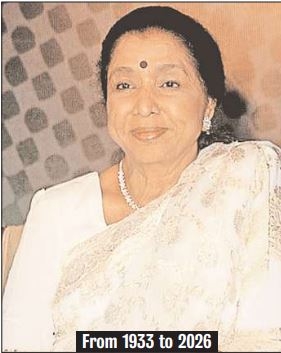
MUMBAI :
HERS was the voice of sass and
soul that struck a million emotive chords down generations,
the one they woke up to in the
morning, tuned into at night,
romanced and mourned loves
that were never to be and yes,
jived and rock and rolled to.
Asha Bhosle was 92. One half
of the Mangeshkar sisters who
togetherbecame thevoices that
not just embodied Hindi playback singing for close to seven
decades but an India keeping
step with the global times.
It should be difficult to separate the Lata-Asha careers but
it is not. Two voices that ruled
the sub continent, representing
a pan identity that knows no
borders. And both now gone,
both at 92. While the elder got
the stardom first, feisty Asha
soon followed suit.Not just sharing the spotlight but expanding
its limits, making it her very own
with verve and astonishing versatility.“Humari saansnahihoti
tohaadmimarjatahai,mereliye
music meri saans hai. (A persondiesif they can’t breathe.For
me, music is like breathing). I
have spent my life with this
thought,” she told PTI ahead of
her 90th birthday in 2023.
Asha was the one who got listeners dancing away to the breathless “Aaja, Aaja” and also sit back
in reflective pause with the classical“JustujuJiskiHai”. Both performed with equal felicity.
What set Asha apart was not
just longevity she sang formore
than eight decades -- but her
reinvention of herself. From
black-and-white cinema to
global stages, from vinyl to
streaming, she stayed relevant
by constantly evolving her
sound. From Meena Kumari and
Madhubala to Kajol and Urmila
Matondkar, the roster of heroines kept changing.
Asha stayed
on as a continuum linking the
past to the present.
The images will live on. The
singing star, always in a sari, a
bindi firmly in place and her
hair tied neatly in a bun. And
gamely dancing to“Ek Mein Aur
Ek Tu” well into her 80s and
most memorably to “Tauba,
Tauba”, recreating Vicky
Kaushal’s signaturehook step at
a Dubai concert in 2024.
With an estimated 12,000
songs, mostly in Hindi but also
in some 20 other languages, it’s
an incredible career, impossible
to take in at one go.
Asha did something unexpected. She reinvented the very
idea of a playback singer. Her
breakthroughcameinthe1950s,
especially through her bold and
peppy songs with composerO P
Nayyar.At a time when play back
singing leaned heavily toward
classical purity, Asha introduced
flair, attitude, and amodernedge.
She became the voice of club
songs, cabaret numbers, and
youth fulromance -- genres others hesitated to embrace.
The next phase of her career
was even more transformative.
Her partnership with R D
Burman redefined Hindi film
music in the 1960s and 70s.
Songs like “Piya Tu Ab To Aaja”
and “Dum Maro Dum” showcased her unmatched versatility. Her voice could be sensuous, playful, rebellious, romantic, plaintive, but always deeply
expressive. Yet, reducing her to
just “versatile” is unfair. Asha
mastered ghazals (“Dil Cheez
KyaHai”), classical-based compositions, pop, and even international collaborations. Her
achievements are formidable:
multiple National Film Awards,
numerous Filmfare Awards, and
the Dadasaheb Phalke Award,
India’s highest recognition in
cinema. She also received the
Padma Vibhushan.