Long after the applause ended, Nagpur remembers Asha Bhosle
| Date :13-Apr-2026 |
Staff Reporter :
The passing of Asha Bhosle marks the end of a defining chapter in Indian music. In Nagpur, her legacy is remembered through her songs, alongside a series of performances and cultural intersections that tied her closely to the city’s artistic life.
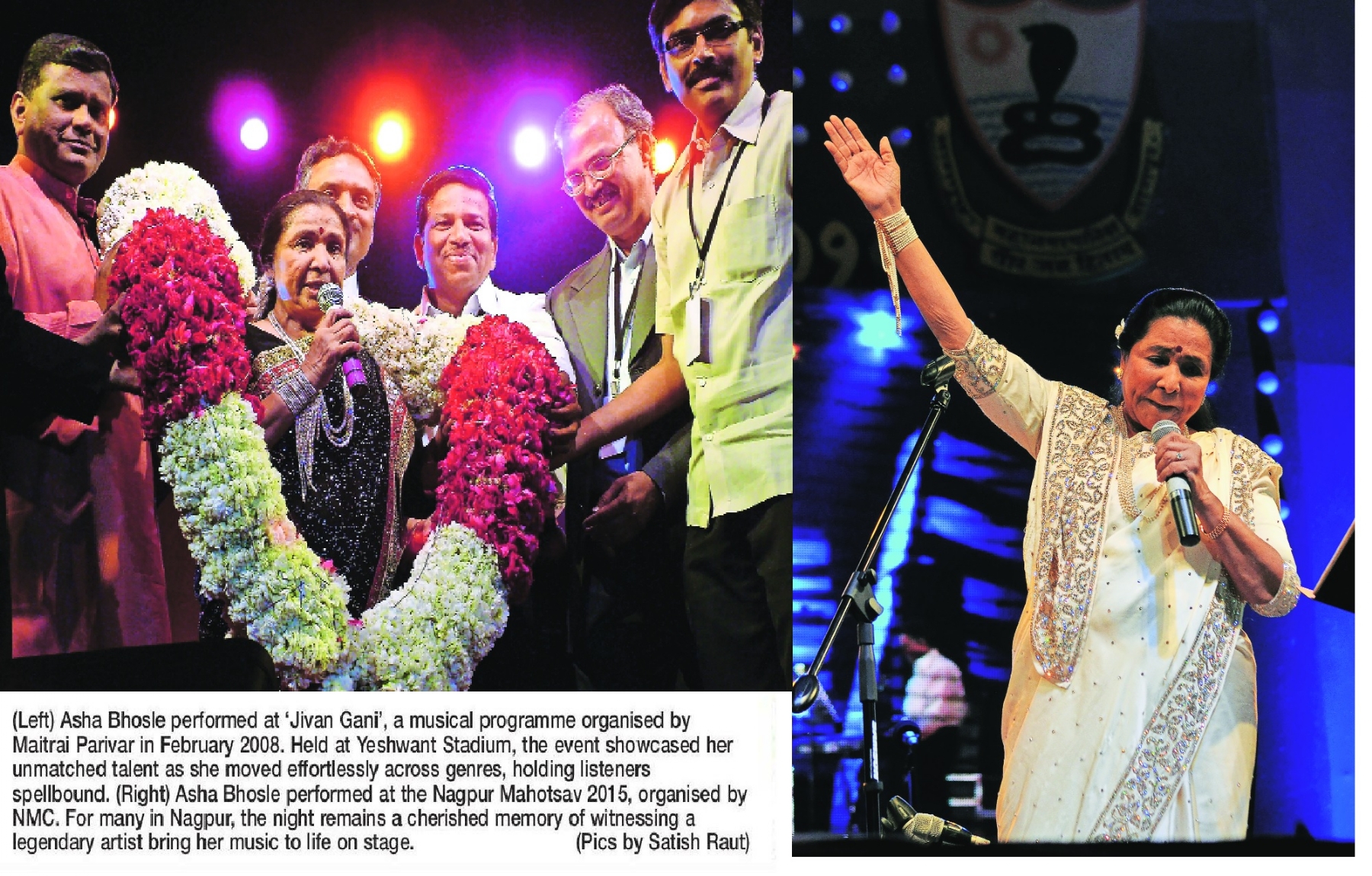
Over the decades, Bhosle performed in Nagpur on several occasions, at a time when such visits by nationally-celebrated artists were considered landmark events. Among her notable appearances was the April 1989 ‘Chitrapat Geet-Bhajan-Ghazal Karyakram’, where artists like Hariharan, Varsha Bhosle, and Sudesh Bhosle were also present.
She later returned to the city for the ‘Deenanath Mangeshkar Smruti Puraskar Samaroh’ held at Yashwant Stadium in April 1997.
The presence of stalwarts (and her siblings) such as Hridaynath Mangeshkar, Usha Mangeshkar, and Lata
Mangeshkar added to the significance of the occasion. Bhosle would go on to perform again at the same venue in later years, including 2008 and 2015.
Apart from live performances, one of the most culturally significant aspects of her association with the region lies in her involvement with the work of Suresh Bhat, a towering figure in Marathi literature, born in Amravati and closely associated with Vidarbha. Bhat’s poetry, revered for its emotional depth and lyrical quality, found a wider audience when set to music by composers like Hridaynath Mangeshkar and rendered by voices such as Lata Mangeshkar and Asha Bhosle.
In April 2016, Bhosle collaborated on a distinctive project titled ‘82’, a western pop-styled Marathi album of Bhat’s ghazals, music-directed by Agashe. Named after her age at the time of recording, the album was completed within a week and featured ghazals originally given to the composer by Bhat. Its televised launch, hosted by Sudhir Gadgil, also included a competition inviting fans to create music videos based on the songs.
For Nagpur, this connection carries particular resonance. Bhat’s legacy is visibly embedded in the city through the Suresh Bhat Auditorium, a prominent cultural venue named in his honour.
It serves as a reminder of the region’s rich literary heritage and the moments when it intersected with voices of national stature like Bhosle’s.
Her performances in Nagpur were occasions that brought together music, poetry, and community. Today, as tributes continue to pour in across the country, Nagpur’s memories of her survive through these experiences of evenings at packed stadiums, of ghazals that carried local poetry to wider audiences, and of a voice that seamlessly bridged the classical, the popular, and the deeply personal.