Where have storybooks gone? Inside Nagpur’s second-hand book market
| Date :13-Apr-2026 |
By Reema Mewar :
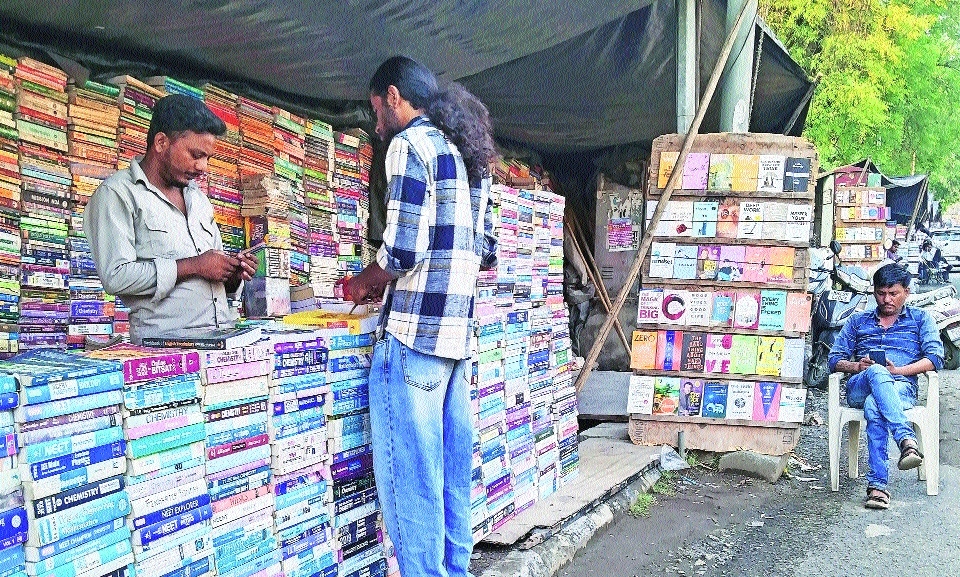
On the pavements and in small stalls across Nagpur, second-hand books are stacked high, but not evenly. Where shelves once held a mix of fiction and non-fiction, today they are largely occupied by exam guides and academic texts. As the market adapts to student demand, questions arise about what is being lost, and whether reading for pleasure is slowly slipping out of reach.
Guides and study material dominate the market
Parvez Hussain, the owner of a second hand book stall, said “These days, donations mostly consist of non-fiction, textbooks, and exam guides. Either people donate them after exams, or some coaching classes also clear out their stock. So that’s what we end up selling the most. Fiction is there, but very limited.”
He also observed, “A lot of kids, maybe from age 13 to 21 or so come and ask for fiction, or novels. They say they want to start reading and ask if I have something simple for beginners,” he says. “Our collection is small, but it feels nice to see that they want to build that habit.”
Libraries are turning
into reading rooms
A possible source of the problem could be a lack of good fiction collections in local libraries. Palak Jethani, a college student and an avid reader, pointed out, “One major problem that I have seen is that libraries are turning into reading rooms. There is hardly a decent collection of fiction books anywhere, and non-fiction is not everyone’s cup of tea. Of course, plently of books are available online, but not everyone can afford them. I think a collection of various kinds of books that are physically visible would really help enhance interest. Like cafes and theatres, bookstores and libraries have the potential to become hangout spots for youngsters.”
Prakash Mananpure, an avid literature enthusiast, expressed concern on the subject, “I believe that fiction is an irreplaceable part of reading, and it is sad to see the rat race we have put the young generation in, where they have forgotten how to read for leisure. There are so many important lessons and concepts that can be learned from reading fiction.”
Books-by-the-box
Books-by-the-box sales (a format where one pays for a box, and fills it with as many books as they can fit), has been a popular concept in the city for several years. Shyam Padole, who organises such sales, explained, “When people don’t have to think about the price of each individual book, they explore more. They pick up things they normally would not,” he said. “And all books at these fairs are donated, or have been purchased at a lower price from wholesalers. We don’t keep academmic books or guides; here, books are for leisure reading.”
He also added that these events bring in a diverse crowd, particularly families.
“We see a lot of parents bringing their children. It’s not just about buying books cheaply, it’s also about teaching them value. They understand that they don’t always have to spend a lot to get something meaningful. This also paints the idea of reusing in a positive light. These books have already been used, but instead of being recycled or thrown away, they are going into someone else’s hands and becoming important again. In many cases, they’re lighting up a child’s world,” he adds.
Nagpur’s second-hand book market supports academic pursuits but struggles to sustain a culture of reading beyond them. Whether that balance can be restored may depend not just on supply, but on how readers choose to engage with books in the future. Perhaps youngsters jostling for better prospects in today’s competitive life find themslves facing immense pressure to succeed at all costs, which may be driving them away from non-serious business; a time where they could delve into fiction which could seriously help them find peace in times of crisis.