City’s Bengali community gears up for Poila Boisakh
Date :15-Apr-2026
‘Dhunuchi Naach’ People perform ‘Dhunuchi Naach’, a traditional Bengali dance, performed with earthen incense burners filled with burning coconut husk and dhuno. Accompanied by rhythmic beats and devotional energy, the performance creates a visually captivating atmosphere and adds as distinct essence to the Poila Boisakh festivities in the city.
Staff Reporter :
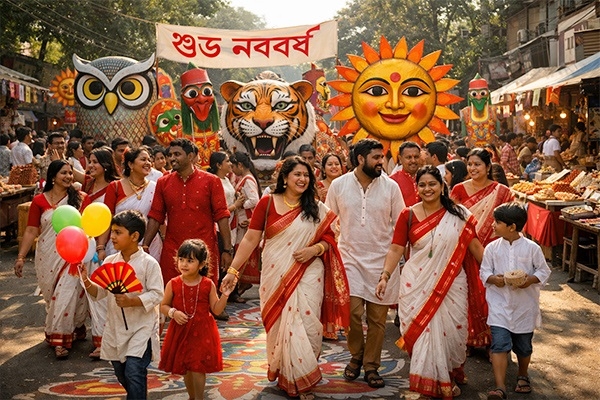
The Bengali New Year, ‘Poila Boisakh’, will be celebrated in the city with great enthusiasm by Nagpur’s Bengali community on April 15. The festival marks the beginning of a new year and symbolises fresh start, prosperity and cultural pride. Over the years, it has grown into a vibrant social and cultural occasion in the city, and has brought together families, friends, and community groups.
Celebrations in city
In Nagpur, several cultural organisations are hosting special events. The Bengali Cultural Society (BCS), is organising an event at Pinewood Lawn, Friends Colony, from 7.30 pm onwards. It will feature cultural programmes, traditional attire, and community participation. A major attraction will be a live performance by Sharmishtha Kundu, a renowned Bengali singer, along with a team of five musicians, on the occasion.
Soumyendu Sarkar, Social Activities Secretary, BCS, and Deputy General Secretary at the Sarbajanin Durga Utsav, Katol, has appealed to all the people to come and experience Bengali culture. Apart from this, Shantiniketan Colony, Pratap Nagar, will also celebrate the Bengali New Year for the first time in the city. The initiative aims to bring people together through music, dance and traditional customs.
New Year rituals and Bengali cuisine
An important part of Poila Boisakh is the traditional ‘Haalkatha’, where traders and shop owners open new account books to mark a fresh financial start. On this day, shop owners perform ‘Ganesh Pujo’ in their shop, seeking blessings for success and prosperity from Lord Ganesha. Customers and well-wishers are invited, and it is customary to distribute new Bengali calendars along with packets of sweets as a gesture of goodwill and continuity.
Food plays an essential role in the celebrations, offering a taste of Bengal’s rich culinary heritage. Festive menus typically feature popular dishes such as ‘kosha mangsho’, a traditional mutton curry, along with ‘maach bhaja’ or fish fry, ‘aloo posto’, a potato dish cooked in a poppy seed (khus-khus) paste, poori, and a mango-pineapple chutney, along with traditional sweets. The celebrations not only add flavour, they also strengthen the cultural roots among Bengalis living away from their homeland.