Itwari Sarafa Oli: Basking in glow of devoted clientele
| Date :19-Apr-2026 |
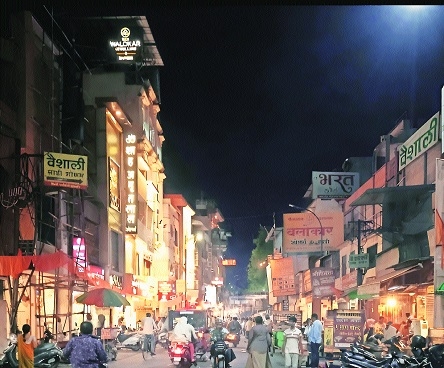
Since the Bhonsle era, the
lanes of Itwari have held the city’s gold trade -- and the
families who built it
By Simran Shrivastava :
ITWARI owes its very name to a market. ‘Itwar’ -- Sunday -- was what people called the weekly bazaar (market) where farmers and traders from surrounding villages would converge to sell grain, cloth, and handcrafted goods. That Sunday market gave this part of Nagpur both its name and its original character. True, the Sunday bazaar is long gone in the form it once took. But what grew in its place -- across the better part of three centuries -- is the Sarafa Oli that Nagpur knows today: Fifty lanes spreading across a single kilometre of the old city, roughly three to four thousand gold and silver shops, and a trade that draws customers from across Vidarbha and beyond.
Vimal Kothari has been sitting in Itwari Sarafa Bazaar for fifty years now. He is seventy. And he says, what only a man who has watched a market
across half a century can say with real authority -- that Itwari did not grow alongside Nagpur, it grew before it. “Itwari was basically old Nagpur,” he explained. “From here, Nagpur was developed. Earlier this was the only area where markets were concentrated.
Then the city expanded.”
The history of the Sarafa market, however, goes back much further than any living memory.
Kishore Dharashivkar -- who has sat in his family’s shop since 1964 and served as ex-President of the Nagpur Sarafa Association, was clear on this point. He told that the market was developed during Bhonsle Rule, who were the Maratha royal house that ruled the Kingdom of Nagpur from 1739 to 1853, and it was under their reign that traders, goldsmiths, and craftsmen gathered in the lanes of Itwari and built the city’s gold hub.
So, what does Itwari actually contain? To the casual visitor walking its lanes, the answer is not immediately clear. But Dharashivkar laid it out with the authority of a man who has spent sixty years inside it. There are at least fifty lanes within a single kilometre of the main road -- each lane running roughly half a kilometre -- and in practically every house along those lanes, some form of gold or silver job work is going on. Some at a large scale, some at a middle level, some in small rooms with a single craftsman.
Among the oldest families in these lanes are the Parekhs, who trace their presence in Itwari to a hundred years ago. Vishal Parekh recounted how his ancestors opened the first shop here, and as the family grew across seven generations, each branch established its own showroom. Parekh shops have been a part of these lanes through the full arc of the twentieth century and into the twenty-first. For Parekh, what keeps a devoted clientele coming back to Itwari despite the arrival of malls and branded chains across the city is the trust.
“Families have been buying here for generations,” he shared. “They know the jewellers personally, and that relationship of faith cannot be replicated elsewhere.”
What has visibly changed across Kothari’s fifty years and Dharashivkar’s sixty is the shops themselves. Where once there were small establishments, there are now large showrooms with imported catalogues and international designs -- because the city around Itwari has grown and the people in it have grown with it. Dharashivkar called it plainly a generation gap -- the first thing he named when asked what six decades in these lanes had shown him.
Yet the chain itself has not changed. The goldsmith in the lane. The craftsman in the house beside him. The wholesaler who comes to buy. The retailer who carries it across Nagpur. And the customer who comes back to Itwari because her mother came here before her, and her mother’s mother before that. “This ancestry is coming,” Dharashivkar said -- meaning not only the jewellery tradition but the people who carry it, generation after generation, back to these same lanes. Who would want to miss that? Who would trade that kind of continuity for a showroom in a mall? Not the people of Nagpur.
Not yet.