Keep corporators updated on water supply disruption: Mayor to admn
| Date :21-Apr-2026 |
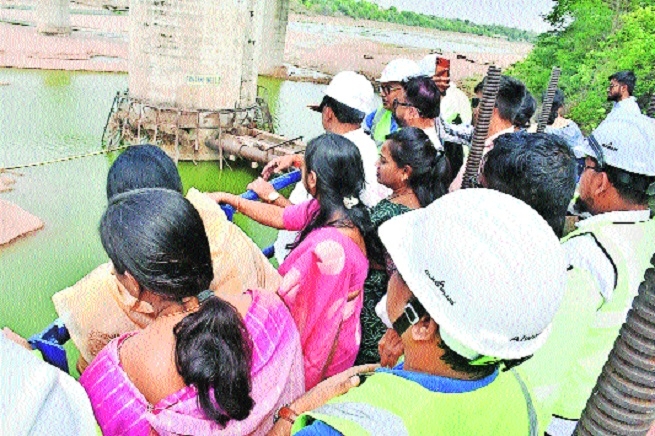
NMC team during tour of Godhni and Kanhan WTPs on Monday.
Staff Reporter :
A single hour of power tripping results in a massive loss of 10 MLD of water, enough to fill five overhead tanks and serve 25,000 citizens
Mayor Neeta Thakre instructed civic administration to maintain the water flow meters installed at the water reservoirs across the city. These water flow meters also help in knowing the level of water available in the elevated storage reservoir (ESR). The directives were given to the Orange City Water Pvt Ltd (OCW) officials present during a comprehensive study tour of the Godhni and Kanhan Water Treatment Plants (WTP) on Monday.
In a major move towards administrative transparency and technical awareness, the Nagpur Municipal Corporation (NMC) organised a comprehensive study tour. Officials including Mayor Neeta Thakre, Deputy Mayor Leela Hathibed, Narendra (Balya) Borkar, Leader of Ruling Party; Sanjay Mahakalkar, Leader of Opposition Party; Shweta Banerjee, Superintending Engineer, Environment; along
with a large delegation of corporators of 38 prabhags and media professionals were present during the tour.
Impact of power
tripping
The primary concern highlighted during the tour was the catastrophic effect of power instability on city’s water supply.
“A single hour of power tripping results in a massive loss of 10 MLD (Million Liters per Day) of water. This is enough to fill five overhead tanks and serve 25,000 citizens.” If a trip occurs at Navegaon Khairi, the city faces a staggering loss of 22 MLD. Even at smaller units such as the Godhni WTP, a trip affects 8 MLD, which can fill four tanks.
Officials noted that it takes at least 30 minutes to restart operations after a trip, creating a significant ripple effect in supply schedules.At the Godhni facility established in 2015, a chemical engineer detailed the sophisticated purification process. The plant utilises a Multi-flow unit, a specialised technology patented by Veolia.
The Treatment Process:
Cascade Aerator: Raw water first enters this section, where dissolved oxygen is increased and toxic gases are removed through air exposure.
Pre-Chlorination and PAC Dosing: Liquid chlorine is added alongside Poly Aluminum Chloride (PAC) to neutralise total suspended solids (TSS) and organic contaminants.
Filtration: The water
passes through TGV filters to ensure clarity.
Quality Assurance: Before the water is pumped into the distribution network, it undergoes a rigorous battery of 85 quality tests.
Kanhan WTP: Pillar of East and North Nagpur
The delegation then visited the Kanhan WTP, which draws from the Kanhan, Pench, and Kolar rivers.
With a capacity of 235-240 MLD, this plant utilises three intake wells to provide nearly 40 per cent of the city’s total water capacity. It primarily serves the areas of Lakadganj, Nehru Nagar, Sakkardara, Ashi Nagar, and Satranjipura.
A major highlighting issue at the plant was the time of monsoon. Every year, when the level of the river rises, pumps inhale soil which block the chambers and results in the blockage of pumps and water slaughtering.
When asked about the solution, officials said that, “Currently
there is no solution, at the
moment we have to short the supply in the areas where we supply water and after few days as the water level drops, the situation becomes normal.”
Demand for Proactive Communication
The tour concluded with a high-stakes meeting where corporators voiced the frustrations of their respective prabhags.
Mayor Thakre instructed the OCW officials, “To send the reading of water levels of the reservoir daily to each corporator.
This will help them to convey the availability of water to the citizens of their area.”
Narendra Borkar issued a stern directive to Orange City Water (OCW) officials regarding communication.
Borkar highlighted that corporators currently receive delayed notifications of a supply disruption. He insisted that, “OCW must call the corporator to provide advance notice of any planned maintenance or potential supply issues so corporators can
effectively manage public expectations and emergency measures in their wards.”
Currently, the city receives a total of 765-786 MLD daily across five WTPs (Pench I, II, III, IV, and Kanhan), with officials maintaining Gorewada as an emergency backup that has yet to be utilised.