Nature’s teaching Wild Himalayan Griffon, captive long-billed vultures soar, forage together in Melghat
| Date :22-Apr-2026 |
By Kaushik Bhattacharya :
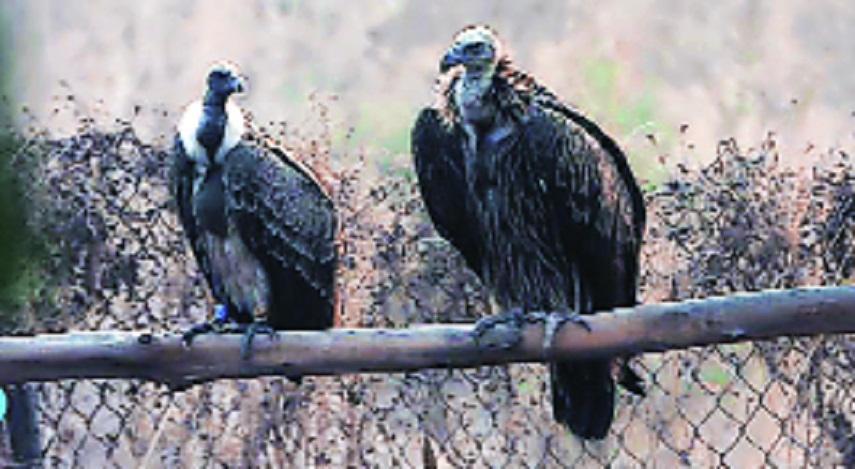
The wild Himalayan Griffon Vulture migrated from high altitude areas to Melghat two months ago where it stayed, socialised and fed with these captive-bred vultures. Now, the wild vulture returned to its home a week ago
In a rare event, a wild Himalayan Griffon Vulture, which stayed in Melghat Tiger Reserve (MTR) for more than two months with captive bred Long-billed vultures, finally returned to its home.
Experts from Bombay Natural History Society (BNHS) believe that the wild vulture helped the captive vultures to soar and forage together which is going to be a life changing lesson for all long-billed vultures that were released in wild a couple of months ago.
According to Bhaskar Das, Conservation Biologist, BNHS, “We monitored the Himalayan Griffon which migrated from other parts of the country and very rare sighting in Central India, socialised and fed with our captive grown vultures in Sumthana range of MTR.”
The wild vulture familiarised with
long-billed vultures easily and started doing all activities together. The most successful activity they did together was soaring and foraging. Our long-billed vultures have grown in captive atmosphere and despite their natural behaviour, the soaring and foraging together is a new thing for captive grown scavengers, Das said while interacting with The Hitavada.
Vultures use their long, broad wings to soar for hours, covering vast areas while consuming little energy. They have exceptional eyesight, allowing them to spot carrion from miles away. Whereas they often gather in large groups called “kettles” to travel. They use “local enhancement,” where they watch other vultures or scavengers (like hyenas) to find food, rather than relying solely on their own scouting. “These activities are important for every scavenger to survive in the wild.
This captive breeding vultures project giving us many lessons as researcher and this rare behaviour of soaring and foraging with their wild counterpart is a new thing for us which is essential for every captive grown vulture,” said Das.
This rare sighting indicates the rewilding programme is successfully drawing wild populations back to a landscape where they were locally extinct for over a decade, said Kishor Rithe, Director, BNHS.
As per the information, the Himalayan Griffon, a species typically found in high-altitude regions and known to migrate seasonally across India, was recorded in Melghat after release of captive-bred vultures in the reserve in February. Shortly after, a Eurasian Griffon Vulture was also observed in Tadoba Andhari Tiger Reserve (TATR), strengthening indications that released vultures are helping re-establish ecological cues for wild populations. Vultures became locally extinct in Melghat and Tadoba nearly a decade ago.
Forest Department and BNHS released 15 long-billed vultures into wild of which 11 stayed in Melghat forest whereas one vulture is now nesting in Pench Tiger Reserve (PTR), Maharashtra. According to Das, one vulture travelled around 600-700 kms and reached Bijapur area in Karnataka where it was exhausted. BNHS rescued the vulture and shifted it to Solapur Transit Treatment Centre (TTC) for some time. Now, the same vulture is nesting in Nashik, he added.
The biologist also informed that remaining two vultures died due to exertion after some time.