A patch in Ambazari Garden that comes alive with butterflies!
Date :23-Apr-2026
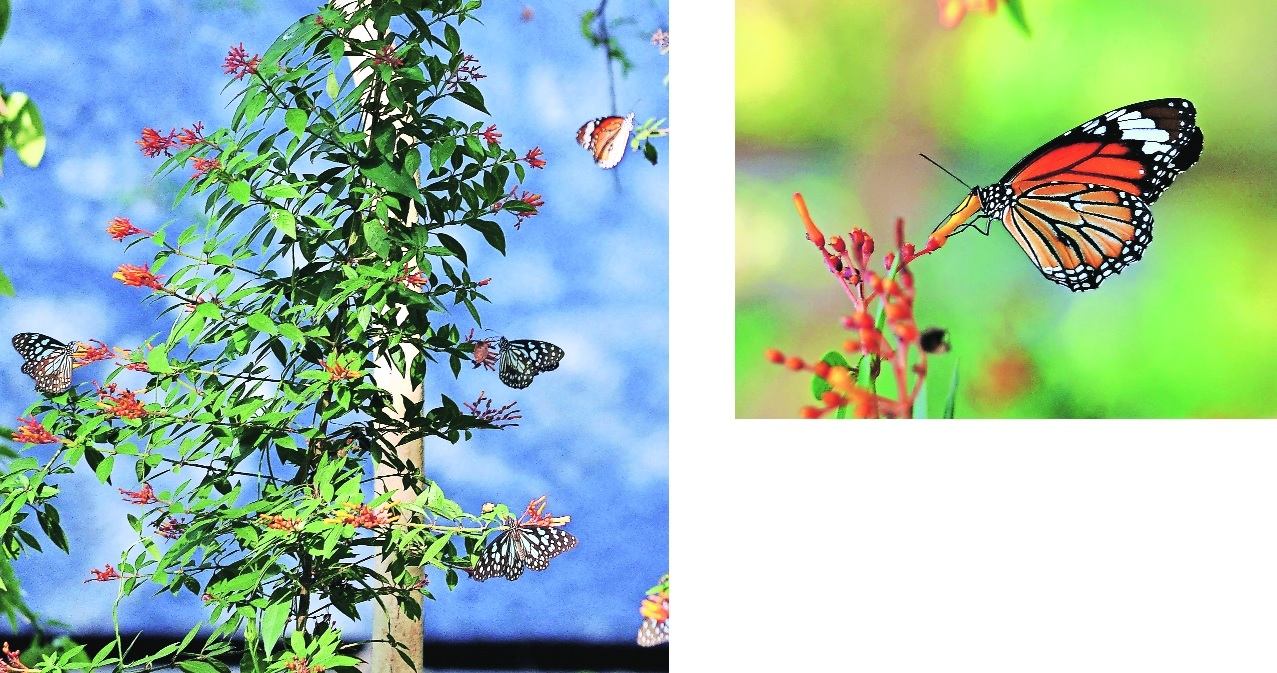
(Left) Clusters of Blue Tiger butterflies (Tirumala
limniace) and Common Indian Skippers (Spialia galba) gather on sunlit vegetation at Ambazari Garden.
(Above) A Plain Tiger butterfly (Danaus chrysippus) spotted in Ambazari Garden, a species commonly found in city’s urban green spaces. (Pics: Anil Futane)
By Reema Mewar :
At first glance, it is just another patch of greenery inside Ambazari Garden. But around 7.30 am, the space begins to change. Butterflies of different species appear in small numbers, then in clusters, settling across the plants for a brief period before dispersing again. The transformation is short-lived, but giving a signal of rich biodiversity of the garden.
Explaining this phenomenon, Dr Sharyu Ghonmode-Fulzele, Professor at Shri Shivaji Education Society, said that, the species are largely common in the city. “Species like the Blue Tiger butterfly, Plain Tiger butterfly, and the Common Indian Skipper are urban adapters. They tolerate disturbance well and breed on weeds and grass. Urban parks in the city have recorded around 60 to 70 different butterfly species over the years.”
Why timing and environment are crucial? According to Dr Sharyu, the timing of their appearance is closely linked to both seasonal and daily environmental changes. “April falls in a declining, pre-monsoon phase. Many butterflies emerge in late spring before the peak summer heat reduces the availability of host plants,” she said.
Even within the span of an hour, conditions change significantly. “At around 6.30 am, temperatures are still too low for flight, and their wings are often heavy with moisture. By 7.30 am, as it warms up and sunlight becomes stronger, they begin basking and then become active.
That’s why you see them appear suddenly.”
“Such clustering is not random. It depends on the availability of the right ecological conditions. Butterflies rely on host plants for laying eggs and feeding caterpillars, and nectar plants for adult food. If both are present, even a small patch can support them,” she added. Common urban plants like Tridax, Lantana, and marigold often play this role.
Butterfly behaviour: “The clustering observed in Ambazari Garden could be for feeding, basking, or sometimes puddling (when male butterflies gather on damp surfaces to absorb salt and minerals for mating). If multiple butterflies are present, it usually means there hasn’t been recent pesticide use, there is food available, and some level of shelter exists. It acts as a quick indicator of environmental quality.” she explained.
Declining green cover: However, she said that, declining green habitats are a cause for concern, as it leads to a decline in butterfly population. “Urbanisation and shrinking green cover are reducing overall butterfly diversity. While adaptable species continue to survive in cities, more specialised ones are disappearing. Small patches and micro-habitats don’t need to be artificially created or heavily designed. If the natural mix of host plants, nectar sources, sunlight, and minimal disturbance is maintained, they sustain themselves,” she said. “The focus should be on protecting these existing pockets of biodiversity in larger urban spaces, rather than replacing them with manicured landscapes that may look neat but do not support ecological life,” said Dr Sharyu.