Land acquisition compensation for farmers doubled, CM Dr Mohan Yadav terms it as a historic decision of the Cabinet
| Date :23-Apr-2026 |
By Bhavana :
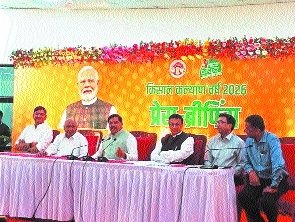
Following the landmark Cabinet decision to double the multiplication factor for rural land acquisition, Chief Minister Dr Mohan Yadav held a press conference at the CM House on Wednesday evening to elaborate on the historic move. By increasing the factor from 1.0 to 2.0, the State has ensured that farmers will now receive compensation totalling four times the market rate for agricultural land, a significant leap from the previous double-rate structure. Terming the decision a historic turning point for Madhya Pradesh’s agricultural community, the Chief Minister emphasised that the simplified acquisition process ensures those providing land for development receive a dignified and fair price.
The Chief Minister explained that this change ensures rural farmers now receive up to four times the market value for their land, a rate that is intentionally kept higher than in urban areas to protect rural interests. This decision, applicable to all agricultural land across the State, follows the recommendations of a ministerial sub-committee comprising Ministers Tulsiram Silavat, Rakesh Singh, and Chetanya Kumar Kashyap.
This formula was adopted after an extensive study of land acquisition rates in three other states and consultations with over 400 stakeholders, including
farmer organisations, CREDAI, and FICCI.
Highlighting the financial scale of this commitment, the Chief Minister noted that while approximately Rs 5,300 crore was previously paid annually as compensation, these new measures will provide a massive boost to farmer income.
Currently, major state bodies like the Madhya Pradesh Road Development Corporation (MPRDC) and the Narmada Ghati Vikas Nigam have compensation outlays of Rs 2,500 crore and Rs 1,000 crore respectively. By resolving compensation bottlenecks, the state expects to significantly speed up pending infrastructure projects that were previously stalled due to acquisition issues.
The Chief Minister also emphasised that the state, situated in the heart of the country, is on a path to double its economic growth rate within the next five years.
Beyond land acquisition, he reassured the farming community regarding crop procurement, stating that the government is purchasing produce at prices even higher than the Minimum Support Price (MSP) to manage this year’s bumper production. Asserting that farmer welfare remains the top priority, the Chief Minister confirmed that the new notification regarding these acquisition rules is being issued and the decisions are effective immediately.
The Council of Ministers also focused on expanding the state’s irrigation footprint with two major project approvals
Indokh-Rudahera Micro Irrigation Project: An administrative sanction of Rs 157.14 crore was granted for this project in Ujjain district. Designed to cover a command area of 10,800 hectares, the project will provide crucial irrigation facilities to 35 villages within the Jharda tehsil.
Chhindwara Irrigation Complex Special Package:
A special rehabilitation package worth approximately Rs 969 crore was approved for the Chhindwara Irrigation Complex, surpassing the previously sanctioned Rs 840.80 crore. This package, modelled after the Ken-Betwa Link Project, aims to ensure swift implementation and support for displaced families.
The Chhindwara complex involves the construction of four dams, Sangam 1, Sangam 2, Ramghat, and the Pandhurna Balancing Reservoir. Once completed, the project will irrigate 1,90,500 hectares of land, benefiting 628 villages across the Chhindwara and Pandhurna districts. The Council of Ministers, chaired by Chief Minister Dr Mohan Yadav, has greenlit a massive investment of Rs 33,985 crore. This extensive funding is earmarked for critical infrastructure and development projects spanning the irrigation, health, education, and road sectors, aimed at transforming the socio-economic landscape of the state over the next five years.
The Public Works Department received a lion’s share of the approvals, with Rs 25,164 crore sanctioned for various connectivity projects. Under this, Rs 7,212 crore has been allocated to the MP Road Development Corporation for road construction and operations from April 2026 to March 2031. Additionally, Rs 6,150 crore is set aside for upgrading rural and district roads, while Rs 1,087 crore will focus on bridge and road enhancements.
The Cabinet also approved Rs 9,950 crore for a large-scale bridge construction scheme aligned with the 16th Finance Commission period, alongside Rs 765 crore for the maintenance of government buildings and assets.
To bolster the State’s healthcare framework, the Cabinet approved Rs 5,479 crore for advanced medical services. A significant portion, Rs 3,628 crore, is dedicated to the “CM CARE 2025” scheme over the next five years. This initiative aims to establish super-speciality hubs in oncology, cardiology, and organ transplantation by leveraging both government investment and private sector expertise. Furthermore, Rs 1,503 crore was sanctioned for upgrading existing medical colleges. Notably, the budget for the new Government Medical College in Mandla was revised to Rs 347.39 crore to accommodate technical requirements due to a site change, ensuring better tertiary care for the tribal region. In a compassionate move, the Cabinet also approved the establishment of affordable ‘Parijan Awas’ (attendant housing) at medical colleges through philanthropic organisations to support families of patients.
The education sector saw an allocation of Rs 2,191 crore, which includes Rs 990 crore to continue the Free Cycle Distribution Scheme for rural students in classes 6 and 9 through 2030-31.
This scheme specifically benefits students who must travel to other villages or towns for schooling. Another Rs 1,200 crore was approved for strengthening teacher training institutes. Additionally, the Cabinet sanctioned Rs 23.90 crore for the third phase of the ‘Chief Minister Young Professional for Development Program,’ aimed at integrating youth expertise into governance. To streamline administrative functions, 15 new posts were also created for the Sixth State Finance Commission.