‘Real need’ for Security Council reform, will push for it: UNSG candidate
| Date :23-Apr-2026 |
UNITED NATIONS :
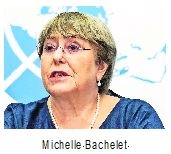
UN Secretary General (UNSG) candidate Michelle Bachelet said there is a “real need” for Security Council reform and greater representation in both permanent and non-permanent categories, vowing to push efforts towards achieving it. Bachelet, the former Chilean President, is one of the four candidates currently in the fray to be the next Secretary General of the United Nations.
The current UN chief, Antonio Guterres, completes his tenure on December 31, after having served two consecutive five-year terms as the world’s top diplomat. “I think it’s a real need for a reform of the Security Council,” Bachelet said here Tuesday in response to a question by PTI on the long-pending UNSC reforms and developing countries like India sitting at the powerful table as permanent members to reflect current global realities.
India has been at the forefront of years-long efforts calling for reform of the Security Council, including expansion in both its permanent and non-permanent categories, saying the 15-nation Council, founded in 1945, is not fit for purpose in the 21st Century and does not reflect contemporary geopolitical realities.
New Delhi has consistently underscored that it rightly deserves a permanent seat at the horseshoe table.
Bachelet said reforming the Security Council is a decision to be taken by UN member states.
“But I think there is an opportunity,” she said, referring to the Pact of the Future, adopted by world leaders in 2024, that gave a strong clarion call to reform the 15-nation body.
Bachelet, who is also the former United Nations High Commissioner for Human Rights, said when people around the world look at the UN, they see the Security Council, they see a body “that is not solving the problem, that is paralysed”, has deadlocks on issues that “really means the suffering of millions of people”.
She stressed that while the UN member states will decide how the Security Council is reformed, but “to really be able to be different”, the Council “needs to have representation of member states who are not represented there - as permanent member or non-permanent members as well, because that’s the only possibility to sort of solve the deadlock, the blockage that’s there”.
Bachelet said that while it sounds too much, there won’t be hope for the multilateral system if the Security Council is not reformed.
“I will do my best to convince, with my good offices... I don’t have the mandate to do that, but I will do my best to try to convince” the UN membership to achieve reforms.
She underscored that in the General Assembly, and also as expressed in the Pact of the Future, there’s a “huge movement” and understanding that the Security Council needs to be reformed.
“In which way will depend on how member states decide, but if I’m selected Secretary General, I will push as much as possible so that it happens,” Bachelet said.
During a three-hour interactive dialogue here on Tuesday, she faced questions from UN member states and civil society about her vision for the position of the next Secretary-General and why she is the best choice for the top job at the UN.
Apart from Bachelet, Secretary-General of the United Nations Conference on Trade and Development (UNCTAD) and former Vice President of Costa Rica, Rebeca Grynspan is the other woman candidate in the running for UN Secretary General.
Head of the International Atomic Energy Agency, Rafael Grossi and former President of Senegal, Macky Sall, are also vying for the position.
The United Nations has been led by nine Secretaries General, all of them men, and has never seen a female leader at its helm in 80 years of its existence.
The Secretary-General is appointed by the 193-member General Assembly “upon the recommendation of the Security Council”, the powerful but divided 15-nation body where China, France, Russia, the UK and the US sit as permanent members and have veto powers.
India last sat at the UN high table as a non-permanent member in 2021-22.
A polarised Security Council has also failed to deal with current peace and security challenges, with Council members sharply divided on conflicts such as the Ukraine war, the Israel-Hamas conflict and the current West Asia crisis.