Red chilli prices escalate in wholesale market
| Date :25-Apr-2026 |
Business Reporter :
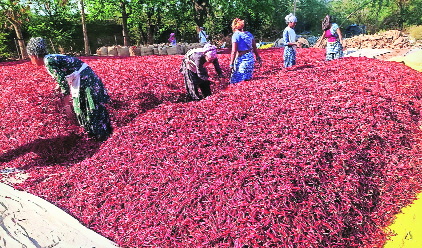
The housewives will have to shed tears as the red chilli prices have escalated due to strong demand and crop shortage this year. This year red chilli prices have opened in the range of Rs 170 per kg to Rs 180 per kg, significantly higher than the previous year’s opening price that started from Rs 160 per kg, at the Kalamna wholesale marketyard.
Experts said that the prices have increased on account of strong consumer demand and lower stock in cold storage that has lifted the red chilli prices this year. Sanjay Wadhwani, a leading red chilli trader told The Hitavada that the red chilli prices across all varieties are higher by 5-10 per cent due to drop in production.
Red chilli prices have surged this year due to a production shortfall, with average prices ruling around Rs 180-Rs 230 per kg across all standard varieties in the Kalamna wholesale market. In retail, the red chilli are being sold at Rs 250-Rs 300 per kg and some premium varieties like the Chapata at Rs 350-400 per kg.
There was a significant decline in output due to reduced acreage of 35 per cent and unfavorable weather conditions that created tight supply of the commodity. Farmers received lower prices for their crop last year, so they reduced the acreage. “Despite weak export demand due to the Middle East conflict, intense buying in spot markets for high-quality, high colour content, and premium varieties like Byadgi pushed prices higher. Lower than expected arrival of the new crop had spurred traders to buy at higher prices,” Wadhwani pointed out.
The popular local varieties consists of Kamal Teja, Armori and Rajura Devanur Deluxe (DD), Singerta, 341, Endo 5, Shark, Romi and Relish. Local varieties like Teja arrive from Kuhi-Mandhar, Bhiwapur, Paratwada, Armori and nearby places of Nagpur to the Kalamna wholesale market. Other varieties like Teja, Byadgi, Khammam, Chapata, Devanur Deluxe (DD) etc., come from Guntur, Warangal, Hyderabad and Karnataka, he mentioned.
Red chillies are exported in bulk quantities from Kuhi-Mandhar, Bhiwapur, Sironcha and Rajura. It is largely exported to China, Singapore, Malaysia, Bangladesh, Europe and Middle East, he added.