Rising mercury, erratic precipitation patterns clear signals of climate change in Nagpur: ESR
| Date :26-Apr-2026 |
By Kaushik Bhattacharya :
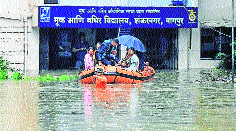
“Rising temperature and erratic precipitation patterns are the clear signals that Nagpur city is at a critical juncture for effectively addressing the challenge of climate change,” claimed Environment Status Report (ESR) 2024-25 released by CSIR-NEERI, recently.
“By implementing comprehensive climate action plans that incorporate urban greening, efficient water management, energy efficiency measures, and advanced adaptation and mitigation technologies, Nagpur can effectively combat the risks posed by climate change,” stated the report.
Whereas, the reality of the ongoing climate change mitigation efforts of Nagpur city is far away for the suggestions made by the latest ESR.
Urban Greening - In the name of mitigation, the authorities are beautifying the road dividers with decorative plants, whereas the rampant illegal tree-felling is underway in every corner of the city without any hearing by the civic body. The Garden Department is itself giving permission to project proponents to fell trees for various infrastructure projects.
Effective Water Management -
All the 11 lakes in the city are struggling for their existence and the three rivers -- Nag, Pilli and Pohra -- are just transporting sewage to the Wainganga River. The NMC is putting some efforts by desilting some lakes of the city to rejuvenate the water bodies, but all the lakes still look like a cement jungle instead of turning blue.
According to ESR, Nature-based Solutions (NbS) are recognised as sustainable, multifunctional tools to mitigate urban heat. Whereas, in the context of Nagpur city, the NbS strategies should be -- urban tree plantation and afforestation along roads, institutions and residential areas; green roofs and walls on public buildings, schools and hospitals; restoration of urban water bodies.
Studies suggest that green infrastructure can reduce surface temperature by 1.70 C to 50 C depending on canopy density, species type, and maintenance-level trees.
However, in Nagpur, only Dharampeth and Mangalwari zones have highest tree cover, while the rest have very less tree cover.
ESR also mentioned that, blue infrastructure, such as ponds and lakes, provide localised cooling effects, especially under hot and humid conditions. Whereas, in Nagpur, many lakes have dried up due to rampant anthropological activities or due to development works. Concretisation is also a major threat to blue infrastructure in city as it chokes the tributary streams.
The intentions of the civic body towards proper mitigation to reduce the impact of climate change is questionable, because the administration delayed in implementing the heat action plan even after maximum temperature crossed 440 C in the city in April. The civic body is planning to reduce number of heat islands from 10 to 8.
The collective efforts of Government, industry and citizens are required for ensuring the city’s sustainable and resilient future. Through proactive planning and the adoption of innovative solutions, Nagpur can serve as a model for other growing urban centres facing similar climate challenges.