20 tiger deaths remain unsolved in Maharashtra since 2020
| Date :29-Apr-2026 |

By Kaushik Bhattacharya :
- NTCA to ‘force-close’ such cases if State fails to complete investigation
- RTI activist claims it is a face-saving exercise by all States to maintain their ranking nationally
- Out of 20 cases, most took place in TATR, one in Pench
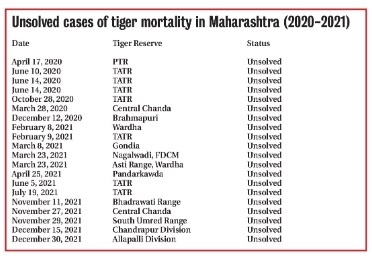
National Tiger Conservation Authority (NTCA) is going to ‘force-close’ 20 tiger mortality cases that took place between 2020-21 in Maharashtra as they remain unresolved, with no confirmed cause, no completed investigation and no accountability fixed.
This development came to light after a Right To Information (RTI) document came out in public domain recently. As per the RTI document, total 88 tiger deaths were recorded between 2020-21 in the country of which 20 deaths happened in Maharashtra which remain unsolved.
These 20 cases span Tadoba-Andhari Tiger Reserve (TATR), Pench Tiger Reserve (PTR), and other tiger reserves outside Maharashtra. In several cases classified as ‘seizures’, tiger parts were recovered, indicating possible poaching, yet investigations have not reached legal closure.
Maharashtra accounts for second highest such unsolved cases in the country after Madhya Pradesh, revealed the report. Out of 20 mortalities, majority cases have been reported from TATR and adjoining areas such as Chandrapur, including regions outside reserve boundaries.
Wildlife conservationist and activist Ajay Dubey from Madhya Pradesh sought the information about latest ‘force-close’ cases of tiger mortality in the country.
Documents revealed that critical investigations into these deaths have stalled, with essential forensic reports, post-mortems and technical analyses missing years after the animals were found dead. The material lays bare a pattern of delayed or incomplete probes in several major tiger states, raising concerns that the agency’s upcoming move to close cases may effectively erase the paper trail of suspected poaching and systemic
failures in protection.
“It is a face-saving exercise by all States in case of tiger mortalities. States intentionally delays to submit technical reports to NTCA which helps in conviction,” said Ajay Dubey while talking with The Hitavada.
“In this process, NTCA is also somehow involved as they never release any tiger death investigation reports in public domain. This practice is in their protocol,” he added.
Whereas, states do their practice to maintain their rankings and keep their reputation at national level, alleged the conservationist. Maharashtra has the highest number of missing cases of tigers in the country which is an alarming scenario and such practice by state governments helping poachers to commit such crime in future as well, said Dubey.
“A notorious poacher was arrested in Maharashtra couple of years ago and the case is still going on. In such cases, when states get success in capturing a big poacher, they should complete the investigation on time and convict him for all his crime,” explained Dubey.
Such delay encourage and increase confidence among poachers that the system has no power to convict them and they will get relief from the case soon, he claimed. Dubey warned that without establishing the cause of death, it becomes difficult to pursue criminal cases or fix responsibility, potentially allowing wildlife crime to go unpunished.
The wildlife activist also suggested to frame ‘Nation-wide Tiger Protection Policy’ to maintain transparency in solvency of wildlife crimes and protection of tigers in the country.
He said, “Under this policy, centre should establish a centralise tiger death monitoring eco-system which will directly monitor such crimes in the country.”
Along with this, centre should encourage states by keeping provision in budget to award states if they got success in highest solvency of cases and it also able to cut budget for the states which are performing poorly, explained Dubey.