Prehistoric rock paintings discoveredin cave at Gadpahad Hill in Jashpur
| Date :06-Apr-2026 |
Our Correspondent
IN A discovery that sheds new
light on the region’s ancient past,
prehistoric rock paintings have
been found inside a natural cave
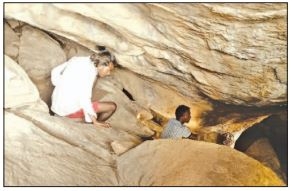
at Gadpahad hill in Jaymarga village of Jashpur district.
The finding not only highlights
the archaeological richness of
the area but also provides
compelling evidence of early
human habitation, preserved
through striking visual
expressions that have endured
the passage of time.
Jashpur, long celebrated for its
breathtaking natural beauty, is
equally significant from an
archaeological standpoint. The
region’s captivating landscapes,
marked by cascading waterfalls,
rugged mountains and naturally formed caves, continue to draw
visitors from far and wide.
The discovery at Gadpahad
further elevates its importance
as a site of historical and cultural relevance. Jaymarga village,
located approximately 30 kilometers from the Jashpur district
headquarters, falls under the
Dadgaon Gram Panchayat in
Manora block and has a
population of nearly 1,400 residents. The village is well connected by road, making it accessible to visitors and researchers
alike. From Jaymarga, the cave
can be reached by a trek of about
300 meters up Gadpahad hill,
cutting through dense forest terrain. The site is not only of archaeological importance but also
holds local cultural significance,
as villagers frequently visit the
cave to offer prayers.
According to the
Archaeologists Dr Anshumala
Tirkey and Baleshwar Kumar
Besra, Jaymarga and its surrounding areas are rich in prehistoric remains.
The region’s natural landscape,
comprising forests, hills, and a
river, would have provided early humans with essential
resources such as food, water, and shelter, making it an
ideal habitat. The cave contains rock paintings depicting
human figures, animals, geometric patterns, and several
unidentified forms, rendered in red and white pigments.
Among the animals illustrated are bulls, leopards, and deer,
alongside human figures that hint at daily life and hunting
practices. Archaeological findings at the site include
tools dating back to the Mesolithic period. Microlithic
implements such as lunates, scrapers, points, trapezoids,
side scrapers, and blades have been discovered, indicating
their use in hunting and other survival activities. Experts
believe the cave may have functioned as a strategic lookout point, enabling prehistoric inhabitants to monitor
wildlife movements.
The presence of hematite, a mineral used for pigment
production, further supports the theory that these paintings were created locally using available natural resources.
Interestingly, stylistic differences among the artworks indicate that the cave was used across multiple time periods,
with some paintings belonging to an earlier phase and others to a later era. This discovery not only enhances Jashpur’s
archaeological profile but underscores the importance of
preserving and studying such invaluable heritage sites,
which continue to illuminate humanity’s distant past.