Two rights do not make a right - and certainly not at Kasturchand Park
Date :07-Apr-2026
Viewpoint
Ar Paramjit Singh Ahuja :
In order to correct the flaw in the design of the Sadar flyover - the landing of which at the Reserve Bank of India (RBI) Square has disrupted the flow of traffic - Metro Rail has proposed adding a branch to it. Vehicles coming from RBI Square will continue to climb the flyover from the existing point, while those from Katol Road and Chhindwara Road will descend onto the road beyond RBI Square via a new landing.
From Liberty Talkies, the flyover will branch towards the Nagpur Improvement Trust (NIT) Head Office, extend up to the Life Insurance Corporation (LIC) Square, pass beneath the Metro viaduct, cut through Kasturchand Park (KP), and finally land just beyond the petrol pump at RBI Square.
The proposed realignment stretches approximately 875 metres.
Let us be clear: this is not a solution. It is a displacement of one problem by creating another.
Because what is being “corrected” in traffic engineering terms is being paid for by a direct assault on Kasturchand Park, a Listed Grade I heritage precinct. Three pillars are proposed to be erected within the Park, with the flyover slicing overhead for around 270 metres.
We are told that a six-metre clearance will ensure that life below goes on undisturbed. That ground-level movement, utilities, and public use will remain “unaffected.”
This is not assurance; it is assertion. And one that strains credibility.
Kasturchand Park is not a vacant plot
waiting to be repurposed at will. It is a protected urban commons - used and valued as open space, as a playground, and as a rare breathing lung in an increasingly congested city. To suggest that erecting concrete
pillars within it and running an elevated roadway overhead will leave it “unaffected” is to stretch the meaning of that word beyond recognition.
The law, in fact, is unambiguous.
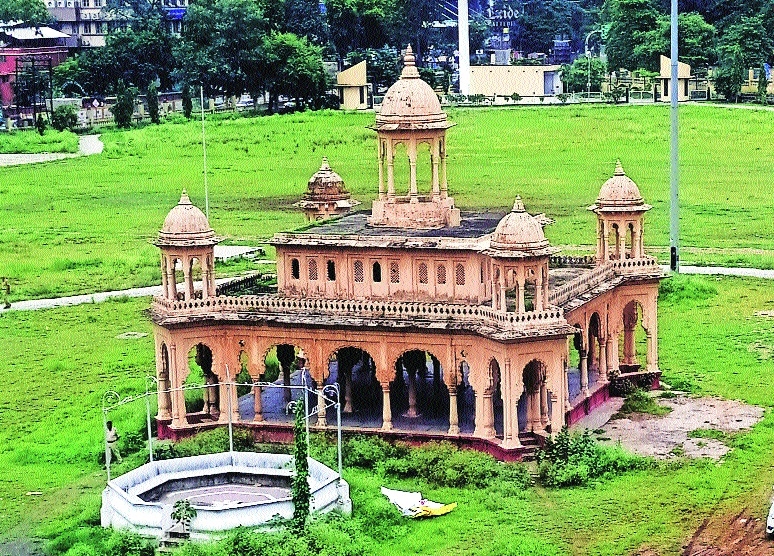
The ‘Regulations for Conservation of Heritage Buildings/Precincts/Natural Features’ for Nagpur, published on October 15, 2003 as part of the Development Control Regulations, lists Kasturchand Park at Sr. No. 95 as a Grade I heritage site under the category “Open Space,” described as a “Significant Open Space in the city.” The designation protects not only the expanse of the Park but also its Chhatri and Bandstand. It is not ornamental protection - it is substantive.
Yet this is not the first time that this protection has been treated as negotiable. The earlier construction of the Kasturchand Park Metro Rail Station within the Park had already set a troubling precedent. The then HCC ought to have been guided by one of several core conservation principles that new infrastructure (Metro Rail, flyover, road, utilities, etc.) must adapt to the protected heritage context leading to realignment or redesign of the infrastructure - not the other way around. In the opinion of this humble writer, the then Heritage Conservation Committee (HCC) erred in granting sanction to that project on three more counts.
First, the most basic obligation was breached: the failure to protect the Listed Open Space.
Second, Clause 11(e), “Vistas/Surrounding development,” was disregarded. It mandates that all development around a Grade I site must be regulated so as not to mar its grandeur or the view from it. By permitting the construction of the Metro station within the Park, the view was not merely compromised - it was blocked.
Third, Clause 11(c) was violated. It clearly states: “No interventions be permitted either on exterior or interior unless it is necessary in the interest of strengthening and prolonging the life of the buildings/precincts or any part of features thereof. For this purpose, absolutely essential and minimum changes would be allowed and they must be in accordance with the original.” The Metro station did not strengthen or prolong the life
of the precinct. It did the
opposite.
And now, with this new proposal, the same protected space is once again being placed on the negotiating table.
The Heritage Conservation Committee is not a passive clearing house. It is a statutory custodian. Appointed by the State Government, comprising eleven members - six ex-officio and five domain experts - it is entrusted with safeguarding 155 listed
heritage structures in Nagpur. Its mandate is not to facilitate convenience, but to enforce conservation.
Yes, pressure from vested interests is inevitable. But institutions are defined precisely by how they respond to such pressure. When a body entrusted with protection begins to rationalise encroachment, it ceases to be a guardian and becomes a gatekeeper.
The Metro Rail’s proposal to carve a branch of the Sadar flyover through Kasturchand Park will come before the Heritage Conservation Committee.
The question is not whether it will be approved. The question is whether the Committee will uphold the law it is sworn to enforce - or once again permit it to be bent in the name of expediency.
Because if a Grade I heritage open space can be repeatedly compromised - first by a station, now by a flyover - then one must ask: what, exactly, does “protection” mean?
And more importantly - who is it for?
(The author is Former Member, Heritage Conservation Committee, Nagpur Municipal Corporation.)